China Best Polymer Tape Casting Machine Manufacturer

Choosing a China-based Polymer Tape Casting Machine manufacturer is not just a price comparison. It is a process decision. The machine must spread a polymer slurry evenly, maintain a stable wet-film thickness, and support controlled drying. Small details matter. A slight coating gap or uneven web tension can create visible variation across the tape. For buyers, useful evidence includes material-specific trial data, documented thickness measurements, and clear descriptions of the casting and drying systems. Photos help, but operating results matter more.

Polymer-processing expert Dr. Chris Rauwendaal’s published work addresses the importance of material flow and process control. A practical paraphrase of that principle is: “Consistent output depends on controlled flow and stable operating conditions.” This is not a verbatim quotation. Use it as a reminder to ask manufacturers how they manage slurry behavior, coating speed, temperature zones, and line adjustments. Ask what happens when viscosity changes. Ask how operators inspect the finished tape. A reliable supplier should explain limitations, not promise perfect results. No machine is perfect. That deserves reflection, especially when product specifications are demanding. Compare technical support, commissioning plans, spare-parts availability, and factory acceptance testing alongside price. The best fit is the machine whose demonstrated process capability matches your material, production goals, and quality requirements.

China Best Polymer Tape Casting Machine Manufacturer

Polymer Tape Casting: Definition and Role in Flexible-Sheet Manufacturing

China Best Polymer Tape Casting Machine Manufacturer

Polymer Tape Casting: Definition and Role in Flexible-Sheet Manufacturing

Polymer tape casting is a process for forming a thin, continuous polymer layer on a moving support. A prepared solution or slurry passes through a controlled gap, then spreads across the surface. The coated sheet travels through a drying zone, where solvents or moisture are removed. The result is a flexible film with a defined thickness and finish.

This process supports flexible-sheet manufacturing by helping control thickness, width, and surface quality. These properties matter in applications such as insulation layers, membranes, and specialty packaging. Operators monitor coating speed, gap settings, mixture viscosity, and drying temperature. A small change in any one can leave streaks, bubbles, or uneven edges. The first setup is rarely perfect; careful trials help reveal what needs adjustment.

How Slurry Preparation, Blade Gap, and Drying Shape Cast-Tape Quality

China Best Polymer Tape Casting Machine Manufacturer

Cast-tape quality begins with slurry consistency. Disperse powders thoroughly, then control binder and solvent addition to avoid lumps or trapped air. A smooth slurry should flow evenly, not feel watery. Let it rest when practical; bubbles can become pinholes after drying. Check viscosity and coating behavior together, since one reading rarely tells the whole story.

Tips: Keep a small sample from each batch. Record mixing time, temperature, and visible changes. A simple note can explain a later defect.

Blade gap sets the wet layer, but it does not guarantee final thickness. Slurry solids, casting speed, and substrate movement also matter. Measure the dried tape at several points across its width. Edge beads or a center-to-edge difference may signal uneven flow, a misaligned blade, or inconsistent support. Small adjustments help; changing several settings at once makes causes harder to identify.

Drying shapes the tape as much as casting does. Excessive heat near the inlet can form a dry skin while solvent remains underneath, leading to cracks or curling. Use staged airflow and temperature where possible, and inspect both edges and center. The right profile depends on the material and line speed. Even with careful controls, a few trial runs may reveal that the expected settings were not quite right.

Machine Structure: Coating Head, Drying Zones, Web Handling, and Rewinding

China Best Polymer Tape Casting Machine Manufacturer

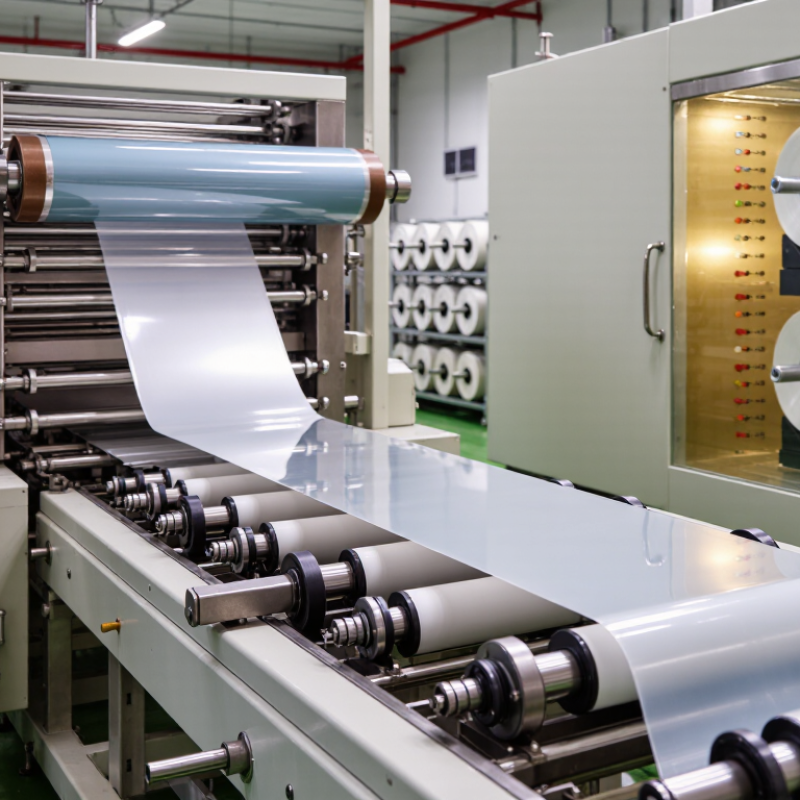
A polymer tape casting machine needs a steady structure to produce an even, usable web. The coating head controls the wet layer through its gap, feed rate, and alignment. A small gap change can leave visible thickness bands across the film. Clean the lip carefully; dried residue can create streaks. Good setup matters.

Drying zones should remove solvent gradually without disturbing the coating. Independent temperature and airflow adjustments help operators manage the transition from wet layer to stable film. Excessive heat near the entrance may skin the surface while moisture remains beneath it. The web-handling section then guides the film over rollers under controlled tension. Too much tension can stretch the tape; too little may cause wrinkles or edge drift. Rewinding should build a firm, even roll, though perfect winding can take several trials.

Tips: Check coating width, web alignment, and roll edges during a slow trial run. Record actual settings, not just target values. Small defects can be easy to miss, so inspect samples under consistent lighting before increasing line speed.

Key Engineering Metrics: 25–1,000 μm Wet-Film Thickness and Line-Speed Control

China Best Polymer Tape Casting Machine Manufacturer

A 25–1,000 μm wet-film range places very different demands on a tape casting line. At 25 μm, dust, vibration, and small die-gap changes can leave visible streaks. Near 1,000 μm, slurry flow and leveling need closer attention. There is no single ideal setting. Material viscosity, solids content, and coating width all affect the result.

Line speed must stay coordinated with slurry delivery, web tension, and the coating head. If the web accelerates but feed does not respond, film thickness may drift. Operators should check measurements across the web, not only at the center, and confirm gauge calibration before changing settings. Small steps help. Fast adjustments can hide the cause of a defect. Real lines are less tidy.

Tips: Record speed, wet thickness, slurry temperature, and tension for each trial. Inspect a fresh coated strip under consistent lighting. If edges look heavier, review flow and alignment before raising speed. One detail is easy to miss: a stable reading at startup does not prove the coating will remain uniform through a long run. Recheck after speed changes, and note any unexplained variation.

Wet-Film Thickness Reference Points

Reference setpoints across the stated 25–1,000 μm wet-film range.

Wet-film thickness setpoints depend on the coating material and process requirements. Line speed is typically controlled in m/min and coordinated with coating and drying conditions; 1 m/min equals 16.67 mm/s. Validate operating settings against the material, equipment, and quality requirements.

Evaluating China-Based Manufacturers: Thickness Tolerance, Automation, and Quality Control

China Best Polymer Tape Casting Machine Manufacturer

When evaluating a China-based polymer tape casting machine manufacturer, start with a defined thickness target, not a brochure claim. Ask whether tolerance refers to cross-web variation, machine-direction variation, or both. Request sample data using the intended resin, width, and line speed. A result from a narrow, slow trial may not predict production. Small distinctions matter.

Check how thickness is measured. A calibrated online gauge can flag drift continuously, while offline micrometer checks verify readings across each roll. Ask for calibration dates, measurement uncertainty, and retained batch records. Automation should coordinate pump output, die temperature, web tension, and winding speed. When these controls are disconnected, a stable average can hide local thin spots.

Inspect practical evidence: changeover procedures, alarm history, defect maps, and operator training records. Request a witnessed trial with agreed acceptance limits, then repeat measurements after restart. Ask how the supplier handles edge build-up, bubbles, and thickness drift during long runs. A clean sample is useful, but it does not prove consistency. Be cautious about demanding tight tolerances before defining test conditions; comparisons can become misleading. The paperwork may have gaps. Look for clear explanations and recorded corrections.

China Best Polymer Tape Casting Machine Manufacturer - Evaluating China-Based Manufacturers: Thickness Tolerance, Automation, and Quality Control
Evaluation Dimension What to Request or Measure Practical Screening Benchmark How to Verify
Wet and dry thickness control Specified coating-thickness range, adjustment resolution, and thickness uniformity across the usable web width. Set the acceptance tolerance for the actual formulation and target gauge. As an initial RFQ screening target, request demonstrated dry-thickness variation within ±5% of the agreed target, subject to product requirements. Run the customer’s material at the agreed speed and width. Measure dry-film thickness at multiple positions across the web and along the roll using a calibrated gauge and an agreed sampling plan.
Thickness measurement and feedback Whether thickness is measured online or offline; sensor type, measurement locations, recording interval, and alarm limits. Online measurement can support faster process correction, but sensor suitability depends on film composition, opacity, surface condition, and thickness range. Require a stated measurement accuracy and calibration method. Compare the machine’s readings with a calibrated reference instrument on representative samples. Review trend data, alarms, and measurement-system calibration records.
Coating-head adjustment Applicator type, gap or die-lip adjustment method, adjustment range, and repeatability after setup changes. Require a documented adjustment procedure and repeatable settings for the intended coating method. No single gap or adjustment resolution is suitable for every slurry or polymer solution. Repeat setup and coating trials, then compare thickness profiles. Confirm that adjustments can be made safely and that the settings are recorded and recoverable.
Web handling and tension Unwind and rewind control, tension-control method, edge guiding, and handling of the selected carrier film. Request a stable run at the agreed line speed and web width, with tension and edge-position limits defined for the actual substrate. Avoid relying on speed claims without a material-specific trial. Observe a continuous run and inspect for wrinkles, edge wander, stretching, slippage, and roll-build defects. Review recorded tension and edge-guide data where available.
Drying and temperature control Oven-zone layout, temperature range, airflow control, exhaust provisions, and temperature-monitoring points. Confirm that the dryer can meet the formulation’s drying profile and solvent or water-removal requirements. Temperature uniformity and exhaust design should be specified for the intended process. Review temperature mapping and airflow information. During a trial, check residual solvent or moisture using a method appropriate to the material and verify that the film is not blistered, cracked, or otherwise damaged.
Automation and recipe management PLC/HMI functions, recipe storage, parameter access levels, alarm history, and export of process data. Request a documented list of controllable variables, including line speed, tension, temperature zones, and coating settings where applicable. Confirm how recipes are saved, backed up, and restored. Ask for a live demonstration: load a recipe, change an authorized setpoint, trigger a representative alarm, and export a run record. Verify operator and administrator access levels.
Quality-control records Inspection procedures, calibration records, material traceability, nonconformance handling, and machine test documentation. Require records that link trial conditions and measurement results to the tested roll or batch. Define acceptance criteria and record-retention expectations before purchase. Review sample inspection reports, calibration certificates, factory acceptance test records, and the proposed procedure for handling out-of-specification product.
Repeatability and process capability Variation between runs, roll-to-roll consistency, and control of critical process parameters. Use repeated trials with the same material, recipe, and operating conditions. Agree on the number of runs and the statistical method before comparing results; a single demonstration roll is not enough to establish repeatability. Request raw measurement data from multiple runs and review thickness profiles, process trends, and any changes made during production.
Factory acceptance and application trial Test material, target thickness, usable width, line speed, run duration, inspection plan, and pass/fail criteria. Use the customer’s material and define the acceptance protocol in writing. Include coating quality, thickness, drying performance, web handling, and data delivery in the trial scope. Witness the test or review a signed report with machine settings, environmental conditions, calibrated measurement results, sample identification, and deviations from the agreed protocol.
Documentation and support readiness Operating and maintenance manuals, electrical and pneumatic drawings, spare-parts list, training, and remote-support arrangements. Confirm that documentation is available in the required language and covers setup, cleaning, maintenance, safety, and troubleshooting for the supplied configuration. Check document samples before order placement and agree on commissioning, training, response channels, and spare-parts availability in the purchase specification.

Note: The numerical screening target above is an illustrative RFQ starting point, not a universal industry standard or a claim about any specific manufacturer. Final tolerances and acceptance criteria should be agreed for the polymer system, coating method, substrate, target thickness, and end-use requirements.

Shopping Cart
Scroll to Top

Search for...

The Duravant family of operating companies serve the food processing, packaging and material handling segments.