

How to Choose a Transparent LED Display Supplier in China?

Choosing a Transparent Led Display supplier in China requires more than comparing prices and glossy product images. The right partner should explain how the display will perform in your actual space, not only in a showroom. Ask about pixel pitch, brightness, transparency, viewing distance, and the weight of each panel. These details affect visibility, installation, and the appearance of the glass behind the screen. Small differences matter.

A reliable supplier should also provide clear technical specifications, sample footage, warranty terms, and a practical plan for installation and after-sales support. Request close-up photos of modules, cables, and frame connections. If possible, review a working sample under lighting conditions similar to your site. Ask how the company tests brightness consistency, heat, and signal stability. Written answers help you compare vendors fairly.

Do not rely on promises alone. A polished brochure can still leave gaps. Check whether the supplier has completed projects with similar dimensions and installation conditions, then ask what went wrong and how the team resolved it. That question may feel awkward, but useful answers reveal more than broad claims. Be careful with unusually low quotes; confirm what is included, such as control systems, spare parts, packaging, and technical guidance. You may not get every detail right on the first call. That is worth reflecting on. A careful shortlist, verified documents, and direct technical questions can help you choose a supplier with confidence.
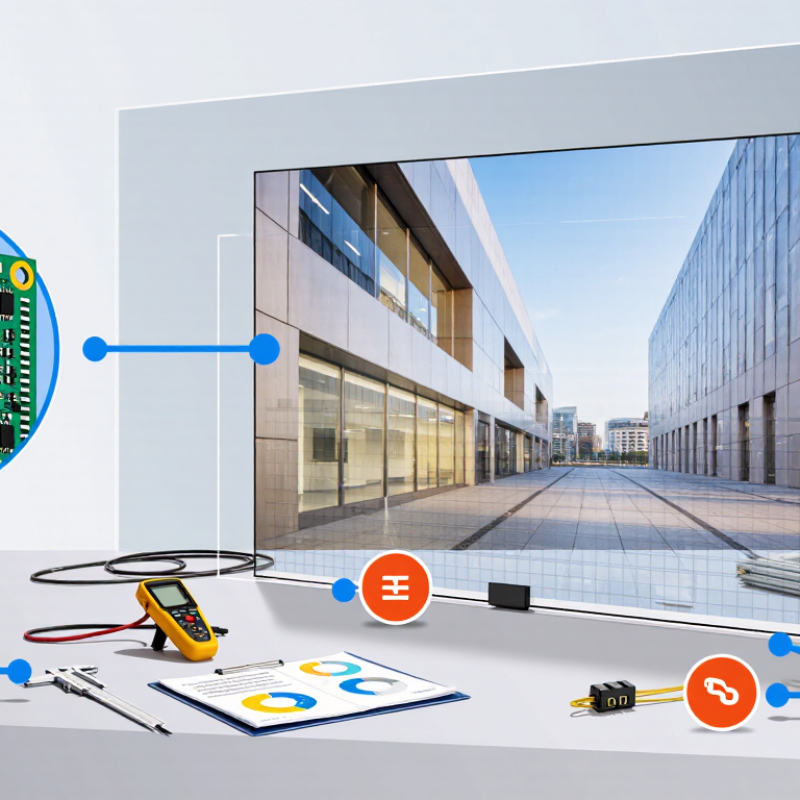
How to Choose a Transparent LED Display Supplier in China?

Define Your Transparent LED Display Project Requirements

Before comparing suppliers, define the job the display must do. Record the installation area, viewing distance, daily operating hours, and whether the glass must remain usable as a window. Measure ambient light at the actual site, not only in a showroom. AVIXA’s 2024 Industry Outlook and Trends Analysis estimated global professional audiovisual revenue at about US$325 billion in 2024. That broad market figure is not a transparent-display forecast, but it reflects the scale of projects where display performance and integration matter. For a supplier inquiry, include a sketch, photos, glass dimensions, control-system needs, and a target brightness range. Specific inputs make quotations easier to compare.

Tips: Ask for pixel pitch, transparency rate, weight per square metre, power consumption, and service access. Request a sample panel or a full-size mock-up under similar lighting. Check how content looks from the intended viewing distance. I still see project teams focus on brightness and overlook reflections, cable routes, or cleaning access. Those details can become expensive later.

Set acceptance criteria before production: uniformity, color consistency, viewing angles, and operating temperature should be written into the specification. Ask suppliers to explain test methods and provide recent, relevant project references—not just product sheets. Confirm lead time, spare-module availability, warranty scope, and who handles commissioning. One requirement may change after a site survey. That is normal; document the revision and update the quotation before placing an order.


How to Choose a Transparent LED Display Supplier in China?

Define your project requirements: match pixel pitch to the audience’s viewing distance.

Example pitch options are commonly available in transparent LED displays. Minimum viewing distance is an approximate rule of thumb: distance in meters ≈ pixel pitch in millimeters. Actual viewing comfort depends on content, installation, and viewing conditions; request a demonstration and confirm specifications with suppliers.

Assess the Supplier’s Manufacturing and Technical Capabilities

A transparent LED supplier’s factory should be judged by repeatable results, not showroom brightness. Ask how it controls LED binning, soldering, module flatness, and inspection. Request production samples and test records for brightness uniformity, color consistency, power consumption, and heat under sustained operation. Numbers matter.

The IEA’s Energy Efficiency 2023 report estimates that lighting uses about 15% of global electricity. That figure is not specific to displays, but it makes measured power use worth checking. Ask for watts per square metre at stated brightness, not a vague “energy-saving” claim. The U.S. Department of Energy’s 2022 SSL R&D Opportunities report also highlights reliability and optical performance as continuing development priorities. A capable supplier should explain how it tests both.

Look for thermal-chamber results, aging-test conditions, and the sample size behind each claim. Ask whether results represent one carefully selected panel or routine production. That detail is easy to miss. Review the actual pixel pitch, transparency, and viewing distance together; a bright panel can still look patchy through glass. Also inspect cable routing and module joins in a working installation. A factory audit helps, but it cannot replace independent test data. I would still ask for a pilot batch before committing to a large order.

Verify Display Specifications, Quality Standards, and Certifications

When checking a transparent LED display supplier in China, ask for a specification sheet tied to the exact model you plan to buy. Compare transparency rate, pixel pitch, brightness in nits, refresh rate, viewing angle, power use, and cabinet weight. Numbers can mislead. Request a working sample and test it in lighting similar to your installation. Check whether text remains readable from the intended viewing distance and whether the display causes noticeable glare.

Ask how the supplier measured transparency and brightness, and request dated test reports where available. Confirm that reports identify the same model and configuration, not a similar product. Review quality procedures for incoming LEDs, soldering, aging tests, and final inspection. If possible, inspect a production unit while it runs for several hours. Flicker, uneven brightness, or loose connectors can be easier to spot in person than in a brochure.

Check certificates against your destination market and the equipment being supplied. A quality-management certificate describes a production system; it does not prove every display meets performance claims. Verify the certificate issuer, validity dates, and listed scope. Ask for applicable electrical-safety and electromagnetic-compatibility documentation, plus installation and maintenance guidance. I have seen buyers focus too much on headline brightness and overlook access for repairs. That is an easy mistake, especially when the first installation looks clean.

Evaluate Samples, Installation Support, and After-Sales Service

How to Choose a Transparent LED Display Supplier in China?

A sample should be more than a small panel glowing on a sales desk. Ask to inspect it at the brightness and viewing distance planned for your site. Check transparency, color consistency, visible seams, and whether text remains readable against daylight. Request a short video showing the sample from both sides, but judge the physical unit yourself. AVIXA’s 2024 Industry Outlook projected global professional audiovisual revenue at about $325 billion in 2024, rising to $402 billion by 2029. This broad forecast signals a growing sector, not proof that any supplier delivers reliable displays.

Installation support deserves the same scrutiny. Ask who surveys the façade, checks mounting points, and coordinates power and signal routes. For a glass frontage, request drawings that show module sizes, access for maintenance, and how cables will be concealed. Confirm whether technicians will attend commissioning and train local staff. Get these details in writing. A polished sample cannot reveal a difficult installation.

After-sales terms should name response times, spare-module quantities, warranty coverage, and remote troubleshooting procedures. Ask how the supplier diagnoses a failed section and whether replacement modules can match the original color. Request a sample service report with private project details removed. Then speak with a past customer, if possible. I would still leave room for doubt: one successful reference is not a pattern. Judge the supplier by documented processes, not confident promises.

How to Choose a Transparent LED Display Supplier in China? — Evaluate Samples, Installation Support, and After-Sales Service

Evaluation Area What to Check Evidence to Request Practical Evaluation Indicator Warning Sign
Product sample Inspect the sample in operation and confirm that it represents the proposed model, pixel pitch, cabinet, and LED configuration. Sample specification sheet, operating video, and written confirmation that the production model will match the approved sample. Compare the sample with the project requirements under the intended viewing conditions, not only in close-up photographs. The sample specification is incomplete, or the supplier cannot explain differences between the sample and the quoted product.
Transparency and visibility Check visibility through the display, image brightness, contrast, and appearance from the intended viewing distances. Clear photographs or video showing both the screen image and the background through the display, with viewing conditions stated. Assess the balance between image visibility and the required level of transparency for the site. Transparency is described with a single figure but without explaining the measurement method or display configuration.
Technical specifications Review pixel pitch, module and cabinet dimensions, brightness, refresh rate, power requirements, weight, and operating environment. Current datasheet, cabinet drawings, electrical details, and a written response to project-specific requirements. Specifications are consistent across the datasheet, quotation, drawings, and sample documentation. Key specifications are missing, inconsistent, or stated without a defined model or configuration.
Sample testing Test uniformity, dead or stuck pixels, color consistency, flicker, signal stability, and normal startup and shutdown. Sample test checklist and agreed inspection criteria, including any pixel-defect acceptance limits. Acceptance criteria are agreed in writing before order confirmation and applied to the delivered product. Quality claims rely only on visual inspection by the supplier, with no agreed acceptance process.
Installation planning Confirm mounting method, structural load information, ventilation, cable routing, access for maintenance, and site responsibilities. Installation drawings, interface details, project checklist, and a clear list of work provided by each party. The proposed design is reviewed against the actual site conditions and coordinated with the local installation team. Installation is described as “easy” without drawings, site requirements, or allocation of responsibilities.
Installation support Clarify whether support is remote, on-site, or provided through training, and confirm availability and any additional costs. Written support scope, communication channels, working-hour coverage, and any travel or service charges. Support arrangements and escalation contacts are confirmed before shipment and aligned with the installation schedule. On-site assistance or response times are discussed verbally but excluded from the written agreement.
Control system and commissioning Verify compatibility with the planned control method, input sources, content workflow, and network or electrical setup. System diagram, controller and software details, configuration requirements, and commissioning procedure. The supplier explains the required hardware, configuration steps, and handover information for the operating team. Compatibility is assumed without checking the project’s signal sources or control requirements.
Warranty and after-sales service Review warranty duration, coverage, exclusions, replacement-part process, troubleshooting, and service response arrangements. Written warranty terms, service procedure, parts availability information, and contact or escalation process. Coverage, claim requirements, shipping responsibilities, and service channels are stated clearly in the contract documents. Warranty terms are vague, or the supplier gives no defined process for diagnosing and resolving faults.
Spare parts and maintenance Ask which modules and components are replaceable, what tools are needed, and how replacement parts are identified. Recommended spare-parts list, maintenance instructions, component labels, and replacement guidance. Spare parts are specified for the exact configuration, with a practical method for identifying and replacing faulty components. Parts are not clearly identified, or replacement depends on returning the full display without a stated process.
Project documentation Confirm delivery of final drawings, configuration files, operating instructions, maintenance guidance, and test records. Document list and handover requirements included in the purchase or project agreement. Documentation is scheduled as part of delivery and commissioning rather than treated as an informal extra. There is no agreed handover package or ownership of configuration files and operating records.

Use this table as a procurement checklist: agree on project-specific specifications, inspection criteria, installation responsibilities, and service terms in writing before placing an order.

Compare Quotations, Lead Times, and Contract Terms

A transparent LED quotation should be comparable line by line, not just by total price. Ask for costs per square meter, pixel pitch, transparency ratio, brightness settings, cabinet weight, control system, spare modules, freight, installation, and commissioning. Request a sample panel or dated test video. Check daylight visibility, not only a dark showroom. Ask for proof.

Compare lead times by milestone: drawing approval, sample sign-off, production, burn-in, packing, shipping, and site acceptance. A supplier’s “30 days” may mean factory completion, not delivery. McKinsey Global Institute’s 2020 report, Risk, resilience, and rebalancing in global value chains, found that 93% of surveyed supply-chain leaders planned to make their supply chains more resilient. Use that as a prompt to ask about component sourcing and contingency stock, not as a delivery guarantee. Dates matter.

Tie payment stages to evidence: approved samples, factory inspection, shipping documents, and final acceptance. Define remedies if brightness, pixel defects, transparency, or dead modules miss agreed limits. Specify the warranty start date, response time, replacement shipping costs, and responsibility for rework. Attach the approved drawings and quotation version to the contract. I would still leave a buffer. A neat comparison table can hide assumptions, so request all exclusions in writing.

Shopping Cart
Scroll to Top

Search for...

The Duravant family of operating companies serve the food processing, packaging and material handling segments.