How to Choose Machine Guarding Doors for Your Facility?
Choosing Machine Guarding Doors is not a cosmetic decision. It affects how operators reach equipment, how quickly they can perform routine tasks, and whether hazardous motion remains inaccessible. The U.S. Bureau of Labor Statistics recorded 5,283 fatal work injuries across all industries in 2023. That figure is not specific to machine guarding, but it underscores why practical risk controls deserve careful attention.
OSHA’s machine-guarding standard, 29 CFR 1910.212, states: “One or more methods of machine guarding shall be provided to protect the operator and other employees in the machine area from hazards.” This is a useful starting point, not a complete door specification. Door selection also depends on the machine’s stopping time, access frequency, cleaning needs, visibility, and the space available around the cell. A door that blocks a hazard but obstructs material flow may invite workarounds. That detail matters.
Look closely at the real task. Does the operator load parts through a sliding door, or enter the enclosure for maintenance? Consider interlocking, panel strength, sightlines, and whether the door can be defeated or left open during production. Verify proposed safeguards against the machine builder’s risk assessment and applicable workplace requirements. OSHA’s wording is authoritative; it is not a substitute for site-specific engineering review. No single door suits every facility. A careful choice balances protection with reliable access, because an awkward safeguard can become an ignored one.
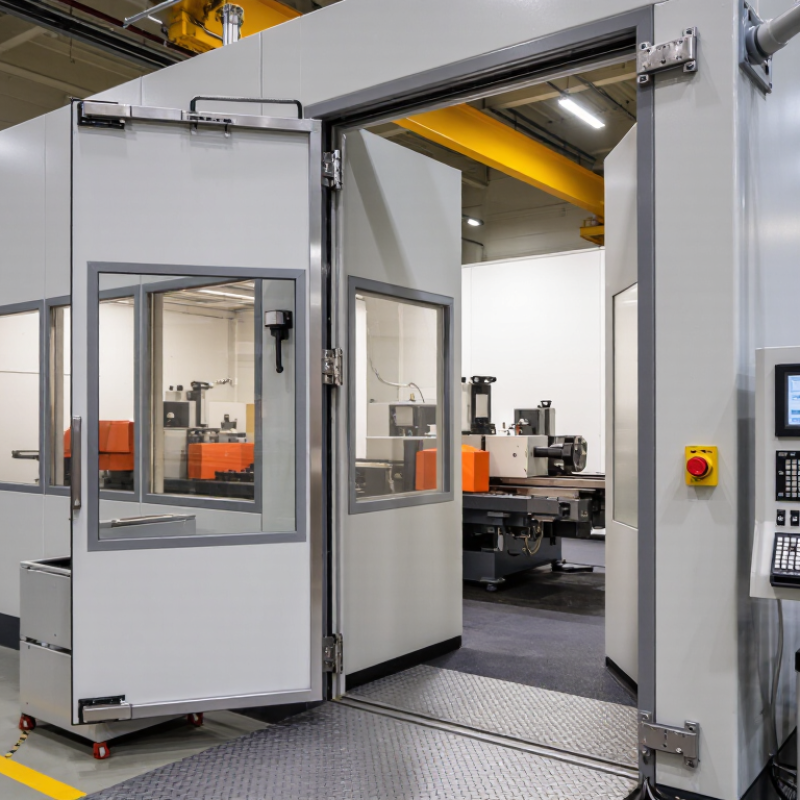
Assess Machine Hazards and Access Requirements
Before choosing a machine guarding door, map each hazard at the point of operation, along moving parts, and wherever material can eject. Note how workers load, clear jams, clean, and maintain the machine. These tasks create different exposure points. A narrow opening near a rotating shaft may be more important than the main access door.
The U.S. Bureau of Labor Statistics reported 738 fatal workplace injuries involving contact with objects and equipment in 2022. This broad category is not limited to machinery, but it shows why access and impact risks deserve attention. OSHA’s machine-guarding requirements also call for guarding against hazards such as rotating parts and points of operation. Small gaps matter. Measure openings and reach distances, then consider how long the machine takes to stop. If a worker could reach danger before motion ends, an interlocked door may need guard locking.
Assess access frequency and the actual work route. A sliding door may suit a tight aisle; a hinged door may need clear swing space. Check visibility, emergency egress, and whether carts or gloves make the handle awkward. A tempting shortcut is copying a nearby cell. It may have different stopping times or maintenance needs. That deserves a second look. Record the hazards, access tasks, and chosen safeguards, then have qualified safety personnel verify the design against applicable standards and the machine’s risk assessment.
Identify Applicable Safety Standards and Regulations
Before choosing a machine guarding door, identify the rules that apply at your facility. Requirements vary by country, industry, machine type, and the edition adopted locally. In the United States, OSHA regulation 29 CFR 1910.212 sets general machine-guarding requirements. Other standards may address specific hazards: ISO 14120 covers guard design, while ISO 14119 addresses interlocking devices. Check current editions and local requirements with a qualified safety professional or regulatory authority.
Small details matter. A door that opens beside a moving spindle needs a different safety review than one enclosing a conveyor. Assess whether an interlock must stop hazardous motion before anyone can reach it, and whether trapped workers can exit from inside. Consider stopping time, access frequency, visibility, and the distance between the door and danger points. Standards such as ISO 13857 can inform safety-distance decisions, but they do not replace a machine-specific risk assessment. A checklist can look complete and still miss a maintenance task performed with the door open. Document the assessment, confirm the control system’s required performance level, and verify operation during commissioning. Recheck after machine changes; that step is easy to overlook.
How to Choose Machine Guarding Doors for Your Facility? — Identify Applicable Safety Standards and Regulations
OSHA’s general machine-guarding rule identifies four hazard categories to consider when assessing whether guarding is needed. A guard door is one possible solution; choose the type of guard based on the machine’s hazards and your risk assessment.
How to read this chart: Each bar represents one hazard category explicitly named in the regulation. The equal values do not indicate hazard frequency or risk level. Confirm the applicable federal, state, and local requirements before selecting a door or interlocking system.
Source: OSHA, 29 CFR 1910.212(a)(1), General requirements for all machines.
Choose a Door Type and Interlocking System
A machine guarding door should match how people actually reach the equipment, not just the shape of the opening. Hinged doors work well where there is room for a clear swing. In a narrow aisle, that swing can obstruct a route or strike nearby fixtures. Sliding doors avoid this, but their tracks need protection from chips, dust, and coolant. Large lift-up panels may suit overhead access, though they need reliable support and enough headroom.
The interlocking system depends on the hazard and how quickly it stops. A basic interlock signals the control system when the door opens; it does not physically stop someone from opening it. If hazardous motion continues after an opening request, a guard-locking device may be needed until the motion has stopped. Small details matter. Check whether the door can be opened from outside, whether the switch stays aligned after repeated use, and whether the control system detects a fault.
Map the access task before choosing: note its frequency, duration, and the tools workers carry. A door used every few minutes needs different ergonomics from one opened only for maintenance. Still, convenience cannot replace a risk assessment. Verify stopping time, interlock behavior, and the complete safety function with a qualified professional. I might favor a sliding door in a tight space, but that choice is not automatically safer; poor track maintenance can undermine it.
Check Door Materials, Dimensions, and Installation Needs
Choosing a machine guarding door starts with the work around it. A steel mesh panel allows airflow and visibility, while a solid panel can help contain chips or splashes. In washdown areas, check that the material and finish resist moisture and cleaning agents. Polycarbonate offers a clear view, but impact resistance and scratching vary by grade. Ask for technical data rather than judging by appearance.
Measure the actual opening, not just the frame. Record height, width, hinge position, and nearby obstructions such as pipes or cable trays. Check whether the door swings freely or needs to slide. Leave enough clearance for operators and carts. Small details matter. A measurement can still be wrong if the floor is uneven, so verify it at several points before ordering.
Installation needs should shape the choice too. Confirm that the existing frame can support the door, hinges, and latch without flexing. Consider how installers will reach mounting points and route sensors or cables. If access is frequent, test the handle and latch with gloves on. A door that is awkward to close may be left open; that practical risk is easy to underestimate. Have qualified personnel check the finished assembly against the machine’s risk assessment and operating conditions.
Plan Safety Testing and Ongoing Maintenance
A machine guarding door is only effective when its safety functions work reliably in daily use. After installation, have a qualified person test each interlock and confirm the machine stops or prevents operation when the door opens. Repeat checks after repairs, adjustments, or changes to the guarded area. Follow the equipment manufacturer’s instructions and your facility’s risk assessment. Small details matter. A door that closes smoothly may still have a misaligned switch or a latch that fails to engage.
Set a practical inspection schedule based on how often the door is used and the conditions around it. Look for loose fasteners, sagging hinges, cracked panels, damaged seals, and metal dust near moving parts. Before hands-on maintenance, make sure the equipment is safely isolated. Record test dates, results, repairs, and the person who completed the work. These notes help reveal recurring problems, such as a hinge that loosens every few weeks. A checklist is useful, but it can create false confidence if staff only tick boxes. Test it again after maintenance, and report faults promptly rather than working around them.



















