2026 How to Choose a Conical Burr Hand Grinder?
Choosing a Conical Burr Hand Grinder in 2026 is not just about buying the newest model. It is about matching the grinder to your coffee, routine, and budget. A well-made hand grinder can produce consistent grounds for pour-over, AeroPress, or espresso, but not every model handles each method equally well. Burr alignment, adjustment range, build quality, and ease of cleaning all matter. So does the feel of the crank at seven in the morning.
Coffee educator James Hoffmann has emphasized the grinder’s importance in brewing, often expressing the idea this way: “The grinder is the most important piece of equipment in your coffee setup.” That is useful guidance, not a guarantee of perfect coffee. Fresh beans, water, and technique still shape the cup. In this guide, we will look at practical signs of quality: clear grind settings, steady burr movement, a comfortable handle, and a catch cup that does not spill grounds across the counter. Small details count.
There are trade-offs. A compact grinder saves space, yet its capacity may feel limiting when brewing for guests. A finer espresso setting can demand more effort, especially with light-roasted beans. And product specifications do not always reveal how a grinder feels after months of use. We will compare the features that matter, explain what to check before purchasing, and flag where evidence is thin. No grinder is perfect. Your hands, habits, and preferred brew should make the final call.
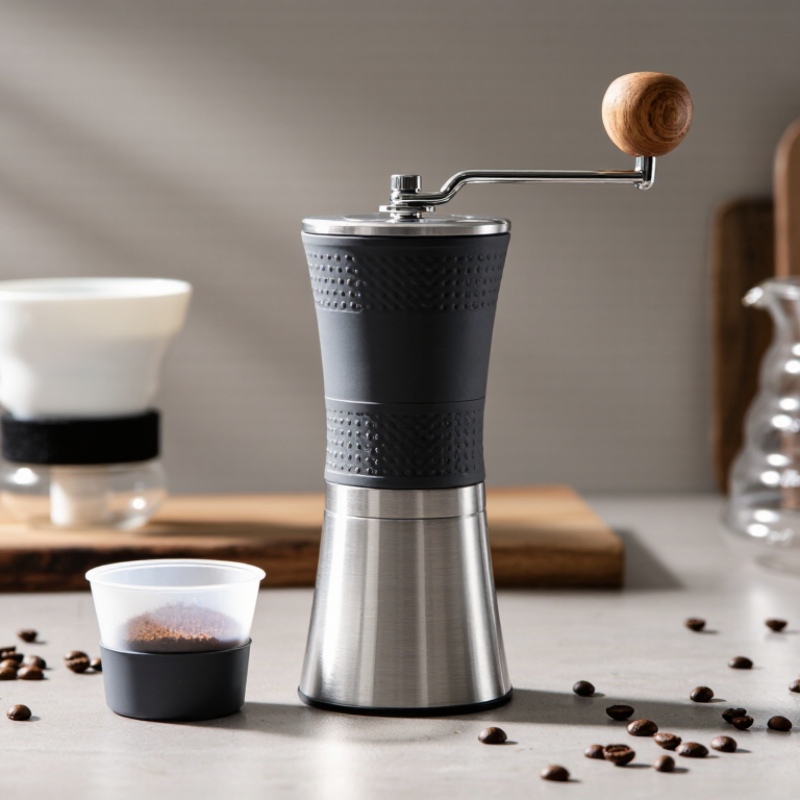
What a Conical Burr Hand Grinder Is and How It Works
A conical burr hand grinder crushes coffee beans between two cone-shaped surfaces. One burr sits inside the other, leaving a narrow gap where beans break into smaller particles. Turning the handle moves the inner burr while the outer burr stays in place. Simple, but not effortless.
A small adjustment changes the burr gap and therefore the grind size. A wider gap makes coarser grounds for methods such as French press; a tighter gap produces finer grounds for espresso-style brewing. The handle’s steady rotation draws beans downward, where ridges on the burrs cut and fracture them. You can feel the resistance increase with denser beans. That feedback is useful, though it is not a precise measurement.
Good burr alignment helps create grounds of more consistent size, which can support more even extraction. Still, no hand grinder produces perfectly uniform particles. A few fines or larger fragments are normal. In daily use, keep the burrs clean and turn the handle smoothly rather than forcing it. I have found that rushing can make the grind less even—and honestly, it is easy to blame the grinder before checking the beans or brewing method.
How Burr Material and Geometry Affect Grind Quality
A conical burr hand grinder turns beans between a fixed outer burr and a rotating inner burr. Material affects wear, heat, and upkeep, but it does not determine cup quality alone. Hardened steel burrs are tough and commonly cut cleanly; ceramic burrs resist corrosion but can chip if dropped. In normal hand grinding, friction is usually brief, so heat matters less than sharpness, alignment, and consistent feeding. Listen for a steady crunch. A sudden change in sound may mean a pebble or uneven beans are slowing the burrs.
Geometry shapes particle size distribution. The cone’s ridges guide beans inward, while the cutting edges shear them into smaller pieces. Burrs with sharper, well-aligned teeth often produce fewer oversized fragments and fine particles, helping water flow more evenly through a brew bed. Still, no grind is perfectly uniform. I find it easy to overrate burr shape from a product description; the same grinder can behave differently with light, dense beans than with darker, brittle ones. Check whether the grind looks consistent, then taste the result: muddy bitterness can suggest excess fines, while thin, sour coffee may point to particles that are too coarse. Make small adjustments. A click or two can matter.
How to Compare Grind Settings and Adjustment Mechanisms
How to Choose a Conical Burr Hand Grinder in 2026?
When comparing grind settings, count useful steps across the range, not just the total clicks. A grinder may offer many adjustments but still jump from too coarse to too fine for espresso. For pour-over, small changes can help you adjust flow and taste. For French press, wider steps may be perfectly practical. Test the setting with the coffee you actually brew.
Feel matters. A clear click should be easy to hear or feel, even when your hands are dusty. Internal adjustment rings can protect the setting during grinding, while external dials are quicker to reach. Check whether the dial stays put in a bag. One detail is easy to miss: some scales start at zero, but zero does not always mean the burrs are touching.
Try adjusting the grinder with one hand, then turn the handle slowly. Does the setting change smoothly, or does it wobble? Fine. Also check how clearly you can return to a previous number after cleaning. A small notebook can help track settings and brew results, though I often forget to use one. That is a useful reminder: precise markings matter less if they are hard to read or remember. Compare adjustment range, stability, and ease of repeatability against your brewing routine.
2026 How to Choose a Conical Burr Hand Grinder?
Comparing Grind Settings and Adjustment Mechanisms
How to read this chart: Fewer degrees between detents means finer angular adjustment. The examples show the math for mechanisms with 12, 24, or 40 detents per full turn (360° ÷ detents); they are illustrative configurations, not specifications for particular grinders. Stepless mechanisms have no fixed detent interval. When choosing a grinder, also check whether its adjustment range suits your brew methods and whether settings are easy to repeat.
How to Assess Capacity, Build, Portability, and Ease of Use
Capacity should match your usual brew, not the largest number on a product page. The Specialty Coffee Association’s brewing guidance uses about 55 grams of coffee per liter of water, so a 300-milliliter brew needs roughly 16.5 grams. A grinder with a 20-gram capacity may suit one cup, but it can feel cramped when making two. Check both bean-hopper and grounds-cup capacity; sellers sometimes emphasize only one. Small detail. Big difference.
Build quality affects consistency and maintenance. Look for a stable handle, a shaft with little side-to-side play, and burrs that sit securely during grinding. Stainless steel can tolerate knocks, while aluminum keeps weight down; neither guarantees a precise grind. A loose adjustment ring can shift during use. I learned to check it after carrying a grinder in a bag. Portability is not just weight: measure the packed height, and check whether the handle detaches or catches on other items. For ease of use, test the adjustment steps, grip, and grounds-cup fit. The SCA Brewing Control Chart places ideal extraction around 18–22 percent, but a hand grinder cannot guarantee that result; bean freshness, water, and technique matter too. Some adjustment markings are hard to read. That gets annoying.
How to Match a Grinder to Your Brewing Methods and Budget
A conical burr hand grinder should match your brew method, not just your budget. For pour-over, look for stable, repeatable adjustments across a medium-to-fine range; uneven grounds can leave a cup both sharp and muddy. For French press, check that the grinder can produce coarse particles without excessive fines. Espresso demands much finer control and smaller adjustment steps, which can make an entry-level hand grinder frustrating. Feel the handle, too. A full dose should turn smoothly, without your wrist fighting every rotation.
Use measurements, not taste alone. The Specialty Coffee Association’s Brewing Control Chart places brewed coffee around 18–22% extraction yield and 1.15–1.35% total dissolved solids. These are reference ranges, not a promise that any grinder will hit them. A scale and a simple brew log can reveal whether a grinder’s adjustments improve consistency. Keep it practical. If you mainly brew one cup of filter coffee, paying extra for espresso-level adjustment may bring little value. If you switch methods often, broader adjustment and easy cleaning matter more. Budget for the grinder and a scale, but leave room for uncertainty: even careful notes cannot make every bean behave the same. A small flaw in my own method? I sometimes change grind size and pouring speed together, then cannot tell which helped.
2026 How to Choose a Conical Burr Hand Grinder? — Match a Grinder to Your Brewing Method and Budget | Brewing Method | Suitable Grind Range | Useful Grinder Features | Typical Capacity | Indicative Budget (USD) | What to Prioritize |
| French press and other immersion brews | Coarse to medium-coarse | Consistent particle size, secure adjustment settings, comfortable crank | About 25–40 g | $25–$60 | Look for steady grinding and an easy-to-clean grounds chamber. Very fine adjustment is usually less important for this method. |
| Pour-over and drip coffee | Medium to medium-fine | Repeatable adjustment, stable handle, burrs suited to filter brewing | About 20–35 g | $50–$120 | Choose a grinder that can return reliably to a preferred setting. This is useful when adjusting grind size to manage brew time and taste. |
| AeroPress and single-cup brewers | Medium-fine to coarse, depending on recipe | Broad adjustment range, compact body, easy dose measurement | About 15–30 g | $40–$100 | A portable grinder with clear adjustment steps suits varied recipes. Check that its capacity covers the dose you normally use. |
| Moka pot | Fine to medium-fine | Fine adjustment control, low wobble, burr alignment | About 15–30 g | $50–$130 | Choose a model that can grind finely without making adjustment difficult. Do not assume every hand grinder is intended for espresso-fine settings. |
| Espresso | Fine, with small adjustment changes | Fine-step adjustment, rigid shaft support, low burr play | About 15–25 g | $100–$250+ | Prioritize precise, repeatable micro-adjustments and a design specifically capable of espresso grinding. Manual grinding at this fineness generally takes more effort. |
| Travel and occasional brewing | Depends on the brew method | Compact construction, protected handle, simple cleaning | About 15–25 g | $25–$80 | Balance portability with comfort and capacity. A smaller grinder may require multiple batches for larger brews. |
| Budget ranges are approximate USD retail estimates for manual conical burr grinders in 2026 and can vary by materials, construction, and market. Capacity refers to a typical single-dose amount; actual capacity depends on the grinder. Burr geometry, alignment, adjustment design, and user technique all affect grind consistency. |