

What Is an LPG Generator and How Does It Work?

An Lpg Generator converts the chemical energy in liquefied petroleum gas into dependable electrical power. It uses propane, butane, or a blended fuel. A pressure regulator meters the gas into the engine. The engine then turns an alternator, producing electricity for lights, pumps, tools, or backup systems.

The World LPG Association reports that LPG serves more than three billion people worldwide, supporting households, businesses, and distributed energy applications. This broad use reflects LPG’s portability and established supply networks. The U.S. Energy Information Administration also identifies propane as a major fuel for residential, commercial, agricultural, and industrial equipment. These sources provide useful context, but fuel availability still differs sharply between regions.

Inside the machine, a battery starts the engine. The governor adjusts speed as electrical demand changes. A cooling system controls temperature, while the exhaust system removes combustion gases. When the load increases, the engine works harder and consumes more fuel. Simple in principle.

Still, an Lpg Generator is not automatically the cheapest or cleanest option. Performance depends on fuel quality, ambient temperature, maintenance, cylinder size, and installation design. The International Energy Agency stresses the importance of efficiency and emissions management across energy systems. That warning matters here. Poor servicing can cause unstable voltage, carbon monoxide risks, and unnecessary fuel consumption. This guide explains the operating cycle, main components, practical benefits, and limitations. It also questions a common assumption: convenient fuel does not guarantee convenient ownership.
What Is an LPG Generator and How Does It Work?

What Is an LPG Generator?

An LPG generator is an engine-driven machine that produces electricity from liquefied petroleum gas. LPG usually contains propane, butane, or a controlled mixture of both gases. It is stored as a liquid inside a sealed tank, then released as vapor before entering the engine. Unlike a battery, the generator keeps producing power while fuel remains available.

The process is practical and fairly direct. A regulator lowers the fuel pressure to a suitable level. The gas then mixes with filtered air inside the engine’s intake system. A spark ignites this mixture, creating controlled combustion. That combustion moves a piston, which turns a crankshaft and alternator. The alternator converts mechanical movement into electrical current for selected appliances, tools, or building circuits.

Clean combustion is one useful feature. LPG generally leaves less soot and fewer fuel residues than many liquid fuels, helping the engine stay cleaner. However, it is not maintenance-free. Filters, spark plugs, oil, hoses, and connections still need regular inspection. A loose fitting can allow gas to escape, while poor ventilation can create serious danger. Keep the unit outdoors, follow local installation rules, and use a qualified technician for fixed connections.

In real use, output can dip when several heavy appliances start together. That detail is easy to overlook. Fuel quality, cold weather, altitude, and incorrect regulator settings can also affect performance. The best setup matches the generator’s rated output with the actual starting and running loads. Allow room for error.


What Is an LPG Generator and How Does It Work?

An LPG generator burns liquefied petroleum gas in an internal-combustion engine. The engine drives an alternator, which converts mechanical energy into electricity. The chart compares the approximate lower heating value of LPG with other commonly used fuels.

Values are approximate lower heating values measured in megajoules per kilogram (MJ/kg). Actual results vary with fuel composition, temperature, engine efficiency, and operating conditions.

How LPG Fuel Powers the Engine

What Is an LPG Generator and How Does It Work?

How LPG Fuel Powers the Engine

An LPG generator uses liquefied petroleum gas, usually propane or butane, to create mechanical power. The fuel stays liquid inside a pressurized cylinder or tank. When the valve opens, a regulator reduces its pressure and allows the LPG to vaporize. The engine then receives the gas through a mixer or fuel-injection system.

The engine draws air through its intake. LPG combines with this air in a controlled ratio. A spark plug ignites the mixture inside the cylinder, producing expanding gases that push the piston downward. This movement turns the crankshaft. The crankshaft drives an alternator, which converts rotation into electrical power. It sounds simple.

In practical use, the regulator and governor must respond to changing electrical loads. A refrigerator starting, for example, may briefly demand more fuel than a lamp. If the mixture or pressure is incorrect, the engine can run roughly, lose power, or stall. Cold conditions can also slow LPG vaporization, especially when the tank is small.

LPG combustion generally produces fewer particulates than many liquid fuels, but it still creates carbon monoxide and carbon dioxide. Safe ventilation is essential. Installations should follow local requirements and be checked by qualified technicians. LPG has an odorant to help reveal leaks, yet smell alone is not a complete safety system. Real-world performance depends on maintenance, fuel quality, temperature, and careful setup.

Key Components of an LPG Generator

What Is an LPG Generator and How Does It Work?

Key Components of an LPG Generator

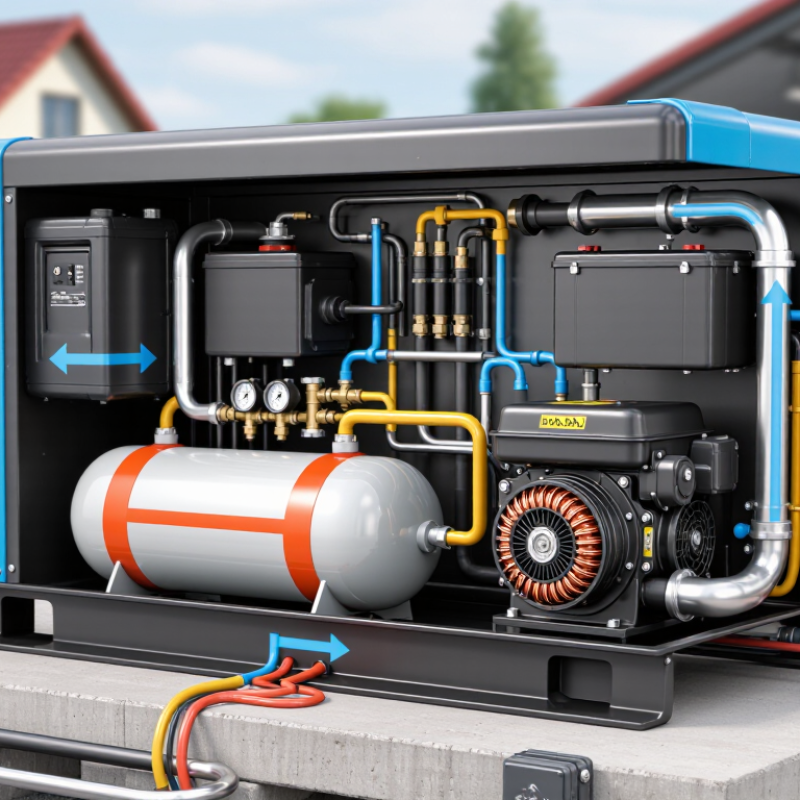
An LPG generator converts propane energy into electricity through controlled combustion. Its fuel system begins with a storage cylinder, shutoff valve, filter, and pressure regulator. The regulator reduces tank pressure before gas reaches the mixer or fuel injector. This step keeps combustion stable.

The engine is the working core. A spark ignites the LPG-air mixture inside the cylinder. Expanding gases push the piston, turning the crankshaft. The alternator then converts rotation into electrical power. A governor adjusts engine speed, while the controller manages starting, voltage, and shutdown functions. The battery starts the engine, and the cooling system removes heat. The exhaust system carries combustion gases away from the enclosure.

Small details matter. The U.S. Energy Information Administration lists propane at about 91,452 Btu per gallon, showing its substantial energy density. However, not all fuel energy becomes usable electricity. Load size, engine condition, altitude, and ambient temperature affect output. The World LPG Association’s 2024 Statistical Review estimates global LPG demand at roughly 331 million tonnes in 2023. That scale reflects LPG’s established role across energy applications, but it does not guarantee every generator will perform equally.

A practical inspection should check hose connections, regulator condition, oil level, battery terminals, and airflow paths. A loose fitting can cause unstable operation. Poor ventilation can also create dangerous exhaust buildup. Generator diagrams often look simple. Real installations are less forgiving.

The Step-by-Step Power Generation Process

An LPG generator converts liquefied petroleum gas into electrical power through a controlled engine cycle. LPG is stored as a liquid in a certified tank, then vaporizes as it leaves the container. A regulator lowers the gas pressure to a stable level. This step matters because unstable pressure can cause rough running or sudden shutdowns.

The process begins when a starter motor turns the engine crankshaft. Air enters through the intake system, while an injector or mixer meters the LPG supply. The two streams combine before entering the combustion chamber. A spark plug ignites the compressed mixture. The expanding gases push the piston downward and rotate the crankshaft. That rotation drives an alternator, where a magnetic field moves around copper windings. Electrical current is produced through electromagnetic induction.

A voltage regulator adjusts the output for connected equipment. The current then passes through protective breakers and travels to the load. Heat moves through the cooling system, while exhaust gases leave through a dedicated outlet. Ventilation must remain adequate, especially in enclosed generator rooms. A qualified technician should inspect hoses, connectors, grounding, and leak protection.

The process sounds simple.

In practice, small errors matter. Poor airflow, contaminated fuel, or an incorrect regulator setting can reduce performance. LPG also requires careful storage and handling. Operators should follow local electrical and fuel-safety requirements, even during short outages. Shutdown normally removes the electrical load first, closes the fuel supply, and allows the engine to cool briefly. The exact sequence may vary with the generator design.

What Is an LPG Generator and How Does It Work? - The Step-by-Step Power Generation Process
Step System or Component What Happens Typical Technical Data Result
1 LPG Storage Tank Liquefied petroleum gas is stored under pressure in a suitable cylinder or bulk tank. LPG remains liquid inside the tank but produces vapor when pressure is reduced. Main fuels: propane, butane, or a mixture of both. LPG has a typical lower heating value of approximately 46–50 MJ/kg. A controlled fuel source is available for the engine.
2 Fuel Shutoff and Safety Valve The fuel line passes through manual and/or automatic shutoff devices. These valves stop fuel flow during shutdown, low oil pressure, overspeed, or other fault conditions. Safety systems are designed to isolate the fuel supply during abnormal operating conditions. Fuel delivery can be stopped quickly to reduce fire and engine risks.
3 Vaporizer or Pressure Regulator The regulator reduces tank pressure to the low pressure required by the fuel system. If liquid LPG must be converted to vapor, heat from the surroundings or engine coolant may assist vaporization. Fuel pressure varies by appliance and generator design; the regulator must match the engine fuel system and local LPG specification. Stable gaseous fuel pressure is supplied to the mixer or injection system.
4 Air-Fuel Mixer or Gas Injection System LPG vapor is mixed with intake air before entering the cylinders. Some engines use a venturi mixer, while others use electronically controlled gas injection. For propane, the chemically balanced air-fuel ratio is approximately 15.7:1 by mass. Actual operation uses a controlled mixture that may vary with load. A combustible air-fuel mixture reaches the engine cylinders.
5 Air Intake and Throttle Control The throttle regulates the amount of air-fuel mixture entering the engine. The governor or electronic controller adjusts engine output as electrical demand changes. Increasing electrical load requires more fuel and air to maintain engine speed and generator frequency. The engine receives the quantity of mixture needed for the connected load.
6 Engine Compression In a typical four-stroke spark-ignition engine, the piston compresses the air-fuel mixture inside the cylinder as it moves upward. A four-stroke cycle consists of intake, compression, power, and exhaust strokes. The mixture is prepared for ignition at a higher pressure and temperature.
7 Spark Ignition The ignition system produces a spark at the spark plug. The spark ignites the compressed LPG-air mixture. LPG generators normally use spark-ignition engines rather than compression-ignition diesel engines. Rapid combustion begins inside the cylinder.
8 Combustion and Piston Movement Combustion raises cylinder pressure and forces the piston downward. The connecting rod transfers this force to the crankshaft. The chemical energy of LPG is converted into reciprocating mechanical motion. The crankshaft receives mechanical torque.
9 Crankshaft and Speed Regulation The crankshaft converts piston motion into rotation. A governor maintains a nearly constant rotational speed as the electrical load changes. Common synchronous-generator speeds are 3,000 rpm at 50 Hz or 3,600 rpm at 60 Hz for two-pole machines; four-pole machines commonly use 1,500 rpm at 50 Hz or 1,800 rpm at 60 Hz. Stable mechanical rotation is delivered to the alternator.
10 Alternator Rotor and Stator The engine turns the rotor inside the alternator. The rotating magnetic field induces an alternating voltage in the stator windings through electromagnetic induction. The alternator converts mechanical energy into electrical energy. Output frequency depends mainly on rotational speed and the number of magnetic poles. Electrical power is produced as alternating current.
11 Voltage Regulation An automatic voltage regulator adjusts the alternator excitation to help maintain the selected output voltage as the load varies. Common low-voltage configurations include approximately 120/240 V or 230/400 V, depending on the electrical system and configuration. Voltage remains within the generator's specified operating range.
12 Control Panel and Protection The control system monitors voltage, frequency, current, oil pressure, coolant temperature, and engine speed. Circuit protection disconnects the load during overloads or faults. Protective functions may include overload, short-circuit, low oil pressure, high temperature, overspeed, and emergency shutdown. The generator operates more safely and can be shut down automatically when necessary.
13 Power Distribution Electricity passes through the circuit breaker, transfer equipment, or distribution panel before reaching connected appliances and electrical loads. Generator capacity is commonly expressed in watts or kilovolt-amperes. Real power is measured in kW, while apparent power is measured in kVA. Usable electrical power is delivered to the connected system.
14 Exhaust and Heat Management Combustion gases leave through the exhaust system, while the cooling system removes heat from the engine. The enclosure or ventilation system helps manage noise and temperature. Exhaust gases contain carbon dioxide, water vapor, nitrogen, and regulated pollutants such as carbon monoxide and nitrogen oxides. Heat and combustion by-products are directed away from the engine and operating area.
15 Shutdown and Cooldown When the generator is stopped, the fuel valve closes and the engine may continue briefly without load to dissipate heat before turning off completely. Cooldown duration depends on engine size, operating load, ambient temperature, and the control system. The generator stops in a controlled manner and remains ready for the next start.
Technical note: Actual fuel pressure, electrical output, efficiency, emissions, voltage, frequency, and operating procedures vary according to generator size, engine design, LPG composition, ambient conditions, and local electrical regulations. LPG generators must be installed and operated with adequate ventilation, approved fuel equipment, correct grounding, and suitable carbon-monoxide protection.

Common Applications and Operating Considerations

An LPG generator burns liquefied petroleum gas in an internal combustion engine. The engine turns an alternator, which produces electrical power. LPG usually contains propane, but its exact composition can vary by supply. This matters because fuel quality affects starting and engine performance.

These generators serve homes, workshops, farms, construction sites, and remote facilities. They can support refrigerators, pumps, lighting, tools, and emergency circuits. They are also useful where diesel storage creates odor or maintenance concerns. A properly sized unit should handle the expected running load and temporary starting surges. Oversizing wastes fuel, while undersizing causes overheating and unstable voltage. Small details matter.

Safe operation begins with ventilation and correct cylinder placement. LPG is heavier than air, so leaked gas may collect in low areas. Keep cylinders upright, protected from impact, and away from ignition sources. A qualified technician should inspect hoses, regulators, connections, grounding, and transfer equipment. Never operate an engine indoors, including inside a garage with the door open. Carbon monoxide can build up quickly.

Cold weather can reduce vaporization, especially when the fuel container is small or nearly empty. Long cables may also cause voltage loss under heavy loads. Operators should check oil, air filters, battery condition, fuel connections, and warning indicators before each use. Do not ignore unusual vibration or a gas smell. Stopping the unit may seem inconvenient, but continuing can turn a minor fault into an expensive failure. Local fuel, electrical, and fire-safety requirements still apply.

Article Source:

Shopping Cart
Scroll to Top

Search for...

The Duravant family of operating companies serve the food processing, packaging and material handling segments.