China Top 10 Industrial Cutting Machine Manufacturers
China’s industrial cutting sector serves automotive, construction, shipbuilding, electronics, and general manufacturing. Buyers comparing China’s top 10 Industrial Cutting Machine manufacturers need more than a ranked list. They need evidence of machine capability, service coverage, and fit for their materials. Small details matter.
Grand View Research’s Laser Cutting Machine Market report estimated the global market at USD 6.7 billion in 2023 and projected a 7.5% compound annual growth rate from 2024 to 2030. This forecast signals opportunity, not guaranteed performance. It also covers laser-cutting equipment, not every technology included under industrial cutting. The distinction matters when comparing fiber lasers, plasma systems, waterjets, and mechanical cutters.
A useful expert perspective comes from Dr. Reinhart Poprawe, a laser-manufacturing specialist and former director of Fraunhofer ILT. His published work emphasizes the importance of matching laser technology and process parameters to the production task. This is a paraphrase, not a verbatim quotation. That practical principle applies to supplier selection: a powerful source alone cannot ensure clean edges, stable throughput, or low operating costs. Buyers should examine cutting samples, stated tolerances, commissioning support, and spare-parts access. Ask for evidence.
The manufacturers in this guide should therefore be assessed by technology, application experience, and after-sales capability—not promotional claims alone. Public data may not reveal every difference between models, and rankings can change with a buyer’s requirements. Use the list as a starting point, then verify specifications directly with each supplier.
Industrial Cutting Machines: Types, Functions, and Core Technologies
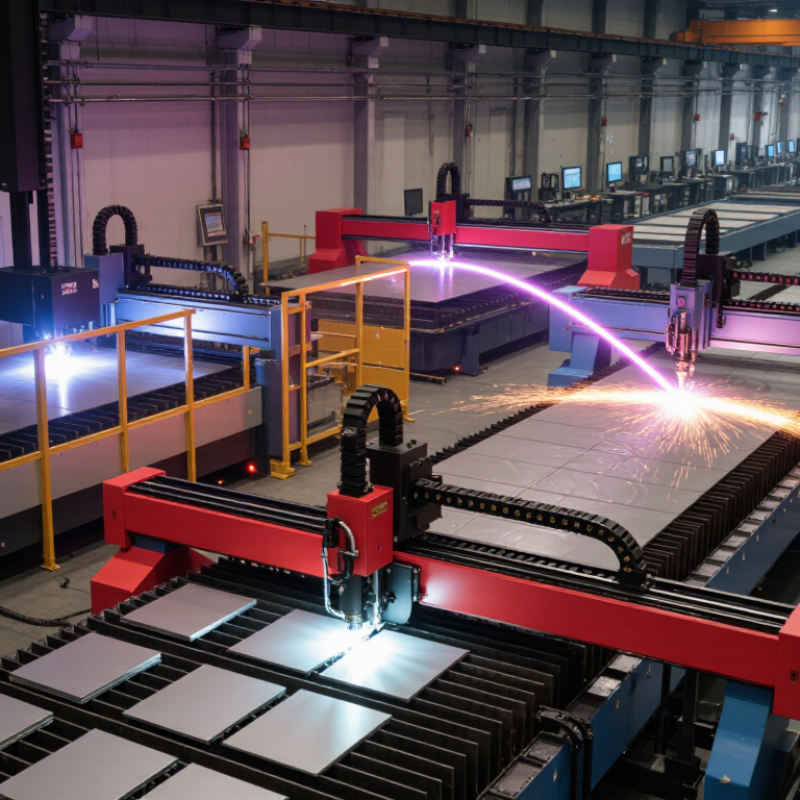
Industrial cutting machines turn digital designs or measured patterns into repeatable parts. Laser systems focus heat on thin sheet; plasma systems use an ionized gas stream for conductive metals. Waterjet machines cut with high-pressure water, sometimes mixed with abrasive, and avoid a heat-affected edge. Mechanical shears and CNC knives suit different sheet, textile, foam, or packaging tasks. Each method has trade-offs. Material thickness, edge quality, speed, and operating cost all matter.
Core technologies coordinate motion, cutting energy, and workpiece positioning. CNC controllers follow programmed paths, while servo drives move the cutting head along calibrated axes. Sensors can monitor distance, pressure, temperature, or process conditions, helping operators spot drift before a batch is wasted. Nesting software arranges shapes to reduce scrap. Extraction, filtration, or cooling systems manage heat, debris, and fumes where applicable. Small details count: a loose fixture can spoil an otherwise accurate cut.
A machine’s brochure settings may not match a real production floor. Test the actual material, thickness, and desired edge before settling on a process. Watch for burrs, taper, discoloration, and dimensional variation. Clean edges help, but they are not the whole story; noise, maintenance access, and operator training affect daily use too. There is no perfect setup. The best choice depends on the part, the shop, and the compromises people are willing to manage.
China’s Industrial Cutting Machine Sector and Its Main Applications
China’s industrial cutting-machine sector supports automotive, shipbuilding, construction machinery, appliances, and metal fabrication. Its equipment ranges from laser and plasma systems to waterjet and mechanical cutters. The right choice depends on material thickness, edge quality, production speed, and shop-floor conditions. A thin stainless-steel panel needs different settings from a thick structural beam. Small details matter.
Demand is closely linked to manufacturing output. The China Association of Automobile Manufacturers reported 30.16 million vehicles produced in 2023, creating substantial demand for accurately cut body panels and structural parts. Applications also include electrical cabinets, farm machinery, and building components, where repeatable dimensions reduce fitting work. The International Federation of Robotics’ World Robotics 2024 report recorded 276,288 industrial robot installations in China during 2023, about 51% of global installations. That figure is not specific to cutting equipment, but it signals the wider move toward automated production lines, where cutting machines may feed robotic welding or assembly cells. Not every factory benefits equally. High-speed systems can still waste material when nesting, maintenance, or operator training is weak. Industry reports describe market activity; they do not guarantee the performance of any individual machine.
Criteria for Assessing Leading Chinese Manufacturers
Criteria for Assessing Leading Chinese Manufacturers
A credible assessment starts with the machine, not the brochure. Request repeatable cut tests on your actual material and thickness. Inspect edge quality, dimensional accuracy, cutting speed, and scrap levels. Ask how accuracy is measured and whether test results include operating conditions. For laser, plasma, or waterjet systems, compare only machines suited to the same process and workload. A polished sample is useful, but it does not prove consistent performance across a full shift.
Manufacturing capability matters, too. The International Federation of Robotics reported 276,288 industrial robots installed in China in 2023, equal to 51% of global installations in its World Robotics 2024 report. This points to a substantial automation base; it does not verify any individual machine maker’s quality. Check production controls, component traceability, documented inspections, and relevant quality certifications. Then assess practical support: spare-parts availability, technician response times, training, and warranty terms. No scorecard is perfect. Service promises can be hard to compare until a line stops.
Tips: Bring a sample part and agree on acceptance criteria before testing. Ask for a written test record. Check the cut edge yourself. A small oversight can change the result.
Profiles of 10 Major Chinese Industrial Cutting Machine Manufacturers
China’s industrial cutting machine sector serves metalworking, signage, textiles, stone, and composite production. The ten profiles below describe different manufacturer types, without relying on brand claims. Buyers should verify machine specifications, service coverage, and sample-cut quality directly.
A sheet-metal specialist may focus on fiber-laser systems for stainless steel and mild steel. A tube-cutting maker typically designs fixtures for round and square profiles. A plasma equipment producer often targets thick plate and fabrication shops. A waterjet manufacturer may serve stone, glass, or heat-sensitive materials. Cold cutting helps.
A CNC-router producer commonly builds machines for wood panels, plastics, and signage. A digital-knife maker may supply packaging and composite workshops. A textile-cutting specialist often emphasizes nesting software and accurate fabric handling. An abrasive-cutting manufacturer may focus on hard or brittle materials. An ultrasonic-cutting supplier can address delicate, layered stock. Finally, an integrated machinery maker may combine cutting, loading, and production-line controls. That breadth can be useful, but integration is not automatically a better fit. Real performance depends on material, operator skill, maintenance, and local support. Specifications alone can mislead.
10 Major Chinese Industrial Cutting Machine Manufacturer Profiles
Each bar represents one manufacturer profile covered. No company names, rankings, or unsupported performance figures are shown.
Product Capabilities and Key Factors for Comparing Manufacturers
China Top 10 Industrial Cutting Machine Manufacturers: Product Capabilities and Key Factors for Comparing Manufacturers
Comparing industrial cutting-machine manufacturers starts with the materials and jobs your workshop actually handles. Check the stated cutting range against your usual plate thickness, material type, and required edge quality. A machine rated for thick plate may cut it slowly or leave extra finishing work. Ask for test cuts using your own material, then record speed, edge condition, and dimensional accuracy. A polished demonstration can mislead. One clean plate proves little. Compare laser, plasma, and waterjet systems by application, not by headline power alone; heat effects, consumables, and operating costs differ.
Controls and support matter too. Examine nesting software, file compatibility, operator training, spare-part availability, and realistic service response times. The International Federation of Robotics’ World Robotics 2024 report counted 4,281,585 industrial robots operating worldwide in 2023. That figure is not a cutting-machine market measure, but it highlights the broader move toward factory automation.
For cutting equipment, check whether loading, unloading, and safety functions can integrate with your production line. Request references for similar materials and shift patterns. Compare warranty terms and documented uptime, not just brochure claims. I would still treat quoted productivity cautiously; actual results depend on setup, maintenance, and operator skill.