
Top 10 Types of Laser Cleaning Equipment
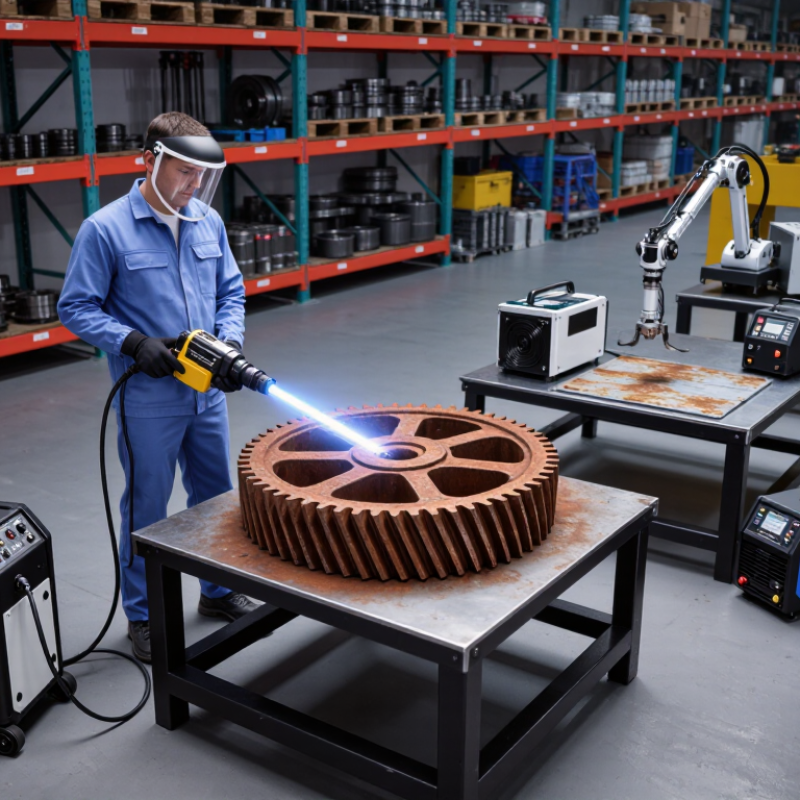
Laser Cleaning Equipment has become a practical choice for removing rust, paint, oil, oxides, and surface residue. It uses focused light instead of abrasive media or chemical solvents. This approach can reduce secondary waste and protect delicate substrates when properly controlled. However, laser cleaning is not a universal solution. The correct equipment depends on material type, contamination thickness, surface geometry, and production speed. A technician cleaning rust from a steel gear needs different settings from a specialist restoring an aluminum component. Small details matter.
This guide explores the top 10 types of laser cleaning equipment used in workshops, factories, maintenance teams, and restoration projects. It considers pulsed, continuous-wave, handheld, robotic, portable, and integrated systems. Each category offers different advantages, limitations, and operating requirements. Pulsed systems often suit precision work, while continuous-wave machines can support faster treatment across larger areas. That assumption is not always correct. Actual results depend on beam control, operator training, cooling design, and testing. Experienced users usually begin with a small inspection area, measure the surface response, and adjust power gradually. Safety remains essential, including suitable eye protection, ventilation, guarding, and documented procedures. The most expensive machine may not be the best fit. A reliable decision comes from matching verified performance with the real cleaning challenge. This comparison aims to support that process with practical, evidence-based guidance.
Laser Cleaning Equipment: Definition, Operating Principles, and Main Components
Laser cleaning equipment removes rust, paint, oil, and oxide layers without abrasive contact. It directs concentrated laser pulses onto a contaminated surface. The contaminant absorbs energy, heats rapidly, and separates through ablation or vaporization. The base material should reflect more energy, but this balance is never perfect. Settings require testing.
The main components include a laser source, beam delivery optics, scanning head, control unit, cooling system, and fume extraction. Enclosures, interlocks, and protective viewing windows support safer operation. Pulsed systems suit delicate surfaces and thin coatings. Continuous-wave systems provide higher heat input for larger, tougher deposits. Handheld units improve access, while automated systems deliver repeatable paths. Small errors matter.
Grand View Research estimated the global laser cleaning market at about USD 587 million in 2023, with continued growth expected through 2030. MarketsandMarkets also identifies industrial maintenance, automotive, and aerospace as important application areas. These reports use different methods, so their forecasts should not be treated as guaranteed results. In practical trials, pulse energy, repetition rate, scan speed, and focal distance strongly influence cleaning quality. A surface may look clean but still contain heat damage or microscopic residue. Operators need calibrated measurements, not visual judgment alone.
Top 10 Types of Laser Cleaning Equipment - Laser Cleaning Equipment: Definition, Operating Principles, and Main Components
Laser cleaning equipment removes contaminants or unwanted surface layers by directing controlled laser energy onto a material. The process relies mainly on selective ablation, vaporization, thermal expansion, or shock-wave effects while keeping the substrate within an acceptable temperature and damage range. Specifications shown below are typical engineering ranges and may vary by system configuration.
| Equipment Type | Typical Laser Source | Typical Wavelength and Output | Operating Principle | Main Components | Typical Applications | Best-Suited Materials and Contaminants |
|---|---|---|---|---|---|---|
| Pulsed Fiber Laser Cleaning Equipment | Q-switched or master-oscillator fiber laser | Commonly 1,064 nm Approximately 20–500 W average power Nanosecond pulses | Short, high-peak-power pulses selectively remove rust, paint, oxide, oil, and other deposits through photothermal ablation and rapid thermal expansion. The low heat input helps reduce substrate distortion. |
| Metal derusting, paint removal, mold maintenance, weld preparation, conservation work, and removal of production residues. | Steel, stainless steel, aluminum, copper, and many coated metal surfaces. Particularly effective for rust, thin paint, oil, and oxide layers. |
| Continuous-Wave Fiber Laser Cleaning Equipment | Continuous-wave ytterbium fiber laser | Commonly 1,064–1,080 nm Approximately 1–20 kW Continuous output | A steady beam rapidly heats and vaporizes or melts contaminants. It provides high material-removal throughput but requires careful control of travel speed, power density, and heat accumulation. |
| Heavy rust removal, large-area coating removal, ship and structural steel maintenance, and high-throughput industrial preparation. | Thick steel components and robust metal substrates. Best for heavy contamination where high productivity is more important than minimal heat input. |
| CO2 Laser Cleaning Equipment | Gas-discharge carbon dioxide laser | Approximately 10.6 µm Commonly 100 W–several kW Continuous-wave or pulsed operation | Infrared energy is strongly absorbed by many organic contaminants, coatings, and water-containing layers. Rapid heating causes vaporization, decomposition, or lifting of the unwanted layer. |
| Removal of paint, polymer residues, rubber deposits, labels, and organic contamination from large surfaces. | Metals, ceramics, stone, and selected heat-resistant materials. Process testing is required because many plastics absorb infrared energy strongly and may deform. |
| UV Laser Cleaning Equipment | Ultraviolet solid-state laser | Commonly 355 nm Approximately 5–100 W Nanosecond or short-pulse operation | Short-wavelength photons can break molecular bonds and provide efficient photochemical ablation. The shallow interaction zone produces low thermal loading and high precision. |
| Precision cleaning of electronics, semiconductor parts, optics, medical components, and delicate coatings. | Polymers, ceramics, glass, thin films, and sensitive metals. Suitable for residues requiring minimal heat-affected zones. |
| Green Laser Cleaning Equipment | Frequency-doubled solid-state laser | Commonly 532 nm Approximately 10–200 W Pulsed or continuous operation | Green light is absorbed differently from near-infrared light by copper, gold, and certain oxides. This can improve coupling on reflective materials and enable controlled removal of thin surface layers. |
| Cleaning and surface preparation of copper components, electrical contacts, precision parts, and selected optical or decorative surfaces. | Copper, brass, gold, and other reflective metals, as well as thin coatings and oxide films where near-infrared absorption is limited. |
| Q-Switched Solid-State Laser Cleaning Equipment | Q-switched Nd:YAG or related solid-state laser | Commonly 1,064 nm Approximately 20–200 W average power Nanosecond pulses | Energy is stored in the laser medium and released in short pulses with high peak power. Contaminants are removed by rapid heating, evaporation, and mechanical stress at the interface. |
| Mold cleaning, cultural-heritage conservation, graffiti removal, oxide removal, and precision surface treatment. | Metals, stone, ceramics, and selected painted surfaces. Effective where controlled pulse energy and moderate cleaning speed are required. |
| Diode Laser Cleaning Equipment | High-power semiconductor diode laser | Commonly 808, 940, or 980 nm Approximately 100 W–several kW Continuous-wave or modulated output | Diode-generated near-infrared energy heats the contaminant and substrate interface. The layer is softened, decomposed, or vaporized depending on absorption and process settings. |
| Broad-area coating removal, pre-weld cleaning, adhesive removal, and treatment of large industrial components. | Coated metals and heat-resistant substrates. Useful for large areas, although thermal management is more important than with short-pulse systems. |
| Picosecond Laser Cleaning Equipment | Ultrafast solid-state or fiber laser | Commonly 1,064, 532, or 355 nm Approximately 10–100 W average power Pulse duration in the picosecond range | Extremely short pulses limit heat diffusion into the substrate. Contaminants are removed mainly through non-linear absorption, rapid ionization, and highly localized ablation. |
| Microelectronics, precision molds, medical devices, thin-film processing, and high-value component cleaning. | Fine coatings, oxides, residues, and delicate surfaces where a very small heat-affected zone is essential. |
| Femtosecond Laser Cleaning Equipment | Ultrafast fiber or solid-state femtosecond laser | Commonly 1,030–1,064 nm or harmonics Approximately 1–100 W average power Femtosecond pulses | Peak intensities exceed the threshold for non-linear absorption, allowing material removal before significant thermal conduction occurs. This supports cold or near-cold ablation in carefully selected conditions. |
| Precision cleaning of optical components, microstructures, medical parts, semiconductor components, and sensitive heritage materials. | Thin contamination layers and delicate substrates that are vulnerable to melting, discoloration, or thermal cracking. |
| Automated Robotic Laser Cleaning Cell | Usually a pulsed fiber, continuous-wave fiber, or diode laser integrated with a robot | Typically 20 W–several kW, depending on the integrated laser source Fixed or scanned beam delivery | A robot or multi-axis motion platform controls the laser head, working distance, angle, speed, and path. Sensors and software can support repeatable cleaning over complex three-dimensional surfaces. |
| Automotive parts, rail components, aerospace structures, large molds, weld preparation, and repetitive production-line cleaning. | Complex or large three-dimensional metal parts requiring consistent process coverage, repeatability, and reduced manual handling. |