
China Top 10 Semi Rigid Borescope Suppliers?
Industrial inspection increasingly depends on tools that reach where hands and cameras cannot. A Semi-Rigid Borescope can guide a small camera through a curved passage, such as an engine compartment or a pipe bend. The result depends on more than image resolution. Probe stiffness, articulation, lighting, working length, and repair support all matter.
The global nondestructive testing market offers useful context for this supplier review. MarketsandMarkets estimated its value at USD 17.5 billion in 2023 and projected USD 23.1 billion by 2028. That broad market includes many testing methods, not just borescopes. Still, it signals sustained investment in inspection across industrial sectors. It does not prove that any one supplier leads.
This guide examines ten China-based Semi-Rigid Borescope suppliers through practical purchasing criteria. These include published specifications, available probe sizes, image and recording functions, customization options, and evidence of service support. A probe’s stated diameter may look convincing on a product page. Its ability to hold position inside a cramped, curved space is harder to judge. That gap deserves attention. Supplier comparisons can also be imperfect when product details, testing methods, or warranty terms are not presented consistently. Readers should verify current specifications, sample performance, and after-sales arrangements directly before placing an order.
Define Semi-Rigid Borescopes: Probe Design, Optics, and 2–8 mm Diameters
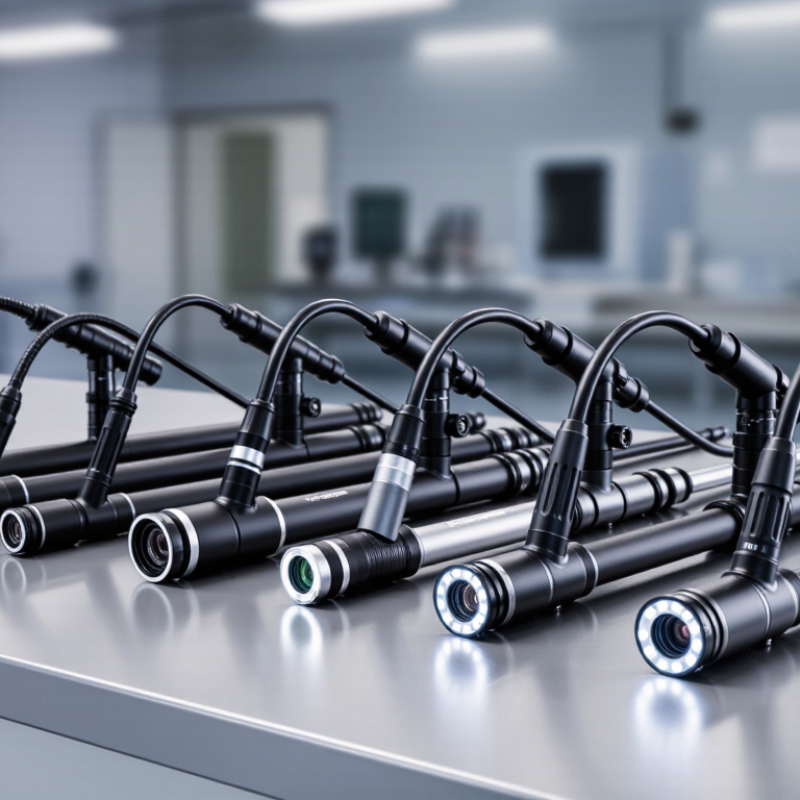
A semi-rigid borescope uses a bendable probe that can hold a guided curve, helping inspectors steer it through confined spaces. Common probe diameters range from 2 to 8 mm. A 2 mm probe may pass through narrow openings, but its smaller optics can make lighting and image detail more demanding. An 8 mm probe generally allows more room for illumination and imaging components, though it needs a wider access path. Small differences matter.
Optical design varies. Some probes transmit images through fiber bundles; others place a digital sensor near the tip. Tip articulation, field of view, focus range, and light output all affect what an inspector can see. A wide view helps locate features, while closer focus can reveal fine surface marks. More detail is not always better. A bright, sharp image can still hide a defect if the probe angle is poor.
The broader inspection market is growing: MarketsandMarkets estimated the industrial inspection market at USD 16.1 billion in 2023, with a projection of USD 21.7 billion by 2028. That figure covers more than borescopes, so it is context, not a borescope sales estimate. In practice, a neat specification can mislead. Check the actual access route, target distance, and lighting conditions before choosing a diameter.

Identify China’s Top 10 Suppliers by Manufacturing, OEM, and Service Capability
China Top 10 Semi Rigid Borescope Suppliers?
Identify China’s Top 10 Suppliers by Manufacturing, OEM, and Service Capability
A useful top-ten shortlist should compare more than catalog prices. Look at manufacturing control, OEM flexibility, and after-sales support. Ask whether the supplier builds probe assemblies in-house or sources key parts. Check available probe diameters, insertion lengths, articulation range, and image resolution against your inspection task. Details matter.
For manufacturing capability, request sample inspection records and clear specifications for the camera head, cable, display, and light source. For OEM projects, confirm customization limits, sample approval steps, packaging options, and realistic production lead times. Service capability deserves equal attention: ask about warranty terms, replacement parts, repair turnaround, and technical support across time zones. A polished catalog is not proof. Compare written responses and sample performance instead of relying on claims alone.
Tips: Send every candidate the same test checklist. Include a narrow pipe bend, a dim cavity, and a close-up target. Record image clarity, steering response, and delivery commitments. Ask for proof. If one detail is unclear, pause and verify it; I would not treat a fast reply as evidence of reliable service.
Compare Key Specs: Probe Length, Field of View, Depth of Field, and IP Ratings
When comparing China’s semi-rigid borescope suppliers, read probe length alongside the inspection route. A longer probe can reach farther, but it may be harder to steer through tight bends. Check whether the quoted length includes the insertion tube, and ask for the minimum bend radius. Small details matter. Field of view also changes what the operator sees: a wider angle covers more of a cavity, while a narrower view can make small features easier to inspect. Compare samples captured at the same working distance, not just catalogue figures.
Depth of field tells you how much of the image stays acceptably sharp. A close-focus probe may show surface cracks clearly, yet lose detail farther down the tube. Ask suppliers to state the near and far focus limits, plus the conditions used to measure them.
IP ratings need equal care. IEC 60529 defines IP6X as dust-tight and IPX7 as protection against temporary immersion under specified test conditions, including up to one metre for 30 minutes. An IP67 label does not prove every connector or accessory has the same rating. One caveat: specification tables can look cleaner than real inspections. Request a practical demonstration on a comparable target, and record image clarity, steering response, and sealing details before ranking suppliers.
Evaluate Imaging and Access: Resolution, Articulation, and Tip-View Options
When comparing China’s semi-rigid borescope suppliers, judge images on a target, not headline pixels. Grand View Research’s Industrial Endoscope Market report estimated the market at about USD 1.1 billion in 2023, with projected growth through 2030. That expansion makes clear specifications more important, not automatically better. Ask for the sensor’s native resolution, working distance, field of view, and a sample image taken inside a narrow tube. Resolution claims can mislead. A bright, sharply focused image may reveal a hairline crack; extra pixels cannot rescue glare or a dirty lens. ISO 12233 describes ways to measure digital-camera resolution, but it is not a borescope certification. Treat a resolution chart as a comparative bench check, not proof of inspection performance.
Articulation should be tested in a real bend. Watch whether the tip reaches a marked side port, holds position, and returns without a sudden jump. A nominal 180-degree bend is useful only if the cable can navigate the actual route. Tip-view options matter too: forward view suits straight passages, while side-view optics can expose wall pits and seams. Some models offer interchangeable views, but changing tips can slow work and introduce handling errors. Bring a representative part to supplier trials. Compare the same target, lighting, and viewing distance. The test will not reproduce every field condition, and that limitation deserves recording. Small details matter.
Verify Supplier Credentials: Quality Systems, Warranty, Lead Time, and Export Support
When comparing China’s top 10 semi-rigid borescope suppliers, treat a ranking as a starting point, not proof of capability. Ask for current quality-system certificates and confirm that the issuing organization and scope match the factory and product. Request inspection records for probe diameter, insertion length, articulation, and image performance. A polished brochure can still leave practical questions unanswered.
Tips: Ask for a sample certificate, warranty terms, and a written lead-time estimate. Check whether warranty coverage includes the probe, screen, and accessories. Request clarification on exclusions, repair procedures, and who pays shipping. Small details matter.
For export support, confirm which documents the supplier can provide and whether staff can respond clearly to technical questions. Ask how production updates are shared and what happens if a shipment is delayed. Compare quoted lead times with realistic production schedules, not just optimistic estimates. If possible, evaluate a sample under your inspection conditions before placing a larger order. One point is easy to overlook: a fast reply before payment does not guarantee dependable support afterward. Keep key promises in writing, and allow time to verify them.