

What Are the Top Steel Heat Exchanger Types in 2026?

Choosing a Steel Heat Exchanger in 2026 starts with the job it must perform, not a product label. Will it cool a viscous process fluid, recover heat from exhaust, or handle clean water under steady pressure? Those details shape the shortlist. Shell-and-tube units remain common in demanding industrial service. Plate-and-frame designs offer compact heat-transfer surfaces and accessible maintenance. Spiral and double-pipe models can suit narrower process needs, though neither is a universal answer.

Thermal researcher Dr. Srinivas Garimella’s published work focuses on heat-transfer systems and their performance. A useful editorial summary of that engineering perspective is: “Match exchanger design to the duty, fluids, and operating limits.” This is a paraphrase, not a verified verbatim quotation. It reflects a practical point: a high-performance design on paper may disappoint when fouling, pressure drop, cleaning access, or uneven flow is overlooked.

Material matters, too. Stainless steel may help resist corrosion in many services, while carbon steel can suit other duties when conditions and protection are appropriate. Check temperatures, fluid chemistry, pressure, fabrication quality, and inspection needs before comparing costs. A detail such as a narrow cleaning port can matter months later. Rankings can help. They can also oversimplify. The sections ahead compare leading steel exchanger types by design, strengths, limitations, and likely applications, so readers can judge which option fits their process rather than chase a single “best” model.
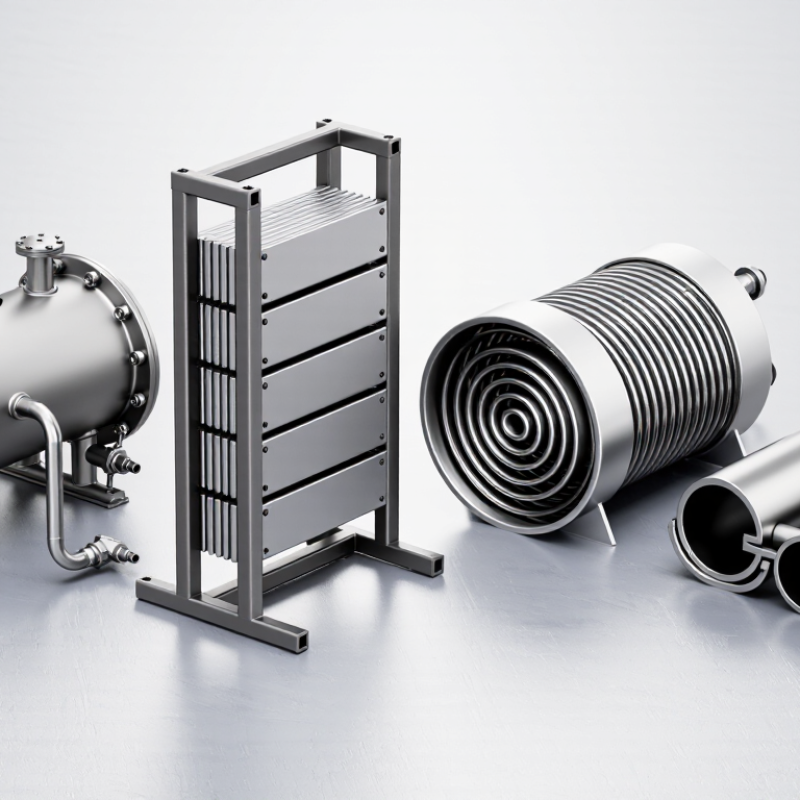
What Are the Top Steel Heat Exchanger Types in 2026?

How Steel Heat Exchangers Transfer Heat

A steel heat exchanger moves heat between two fluids while keeping them in separate channels. Hot fluid flows along one side of a steel wall; cooler fluid passes on the other. Heat travels from the hot fluid to the wall, through the steel, and into the cooler fluid. The fluids usually do not mix. That separation matters.

Inside the equipment, convection carries heat between each fluid and the metal surface. The steel conducts heat across the wall. In a shell-and-tube design, one fluid may flow through narrow tubes while the other moves around them. Plate designs use thin steel sheets to create alternating channels. Counterflow, where fluids travel in opposite directions, can maintain a useful temperature difference along much of the exchanger. Small details matter.

The performance depends on more than steel alone. Flow rate, wall thickness, fluid properties, and available surface area all affect heat transfer. A thin deposit of scale can act like insulation and slow the process. In practice, operators check temperatures, pressure, and signs of fouling rather than relying on calculations alone. The theory is tidy; real systems are not always. Steel also expands as it heats, so the design must account for changing temperatures and stresses. A suitable material and inspection schedule depend on the fluids and operating conditions.

Which Criteria Identify Leading Types in 2026

In 2026, leading steel heat exchanger types are those that match real operating conditions, not simply the highest catalogue rating. Shell-and-tube units suit demanding pressure and temperature ranges, and their tubes can be inspected individually. Plate-and-frame units transfer heat efficiently in a compact footprint, but gasket materials limit some temperatures and fluids. For harsher service, welded plate designs remove gaskets from the process path. Fit matters most.

Compare each option against fluid chemistry, design pressure, temperature swings, fouling risk, and available maintenance access. Stainless steel may resist a particular fluid, but grade selection still needs corrosion data and process expertise. Check documented thermal performance at expected flow rates, pressure drop, cleaning requirements, and service life. A low purchase price can hide energy or maintenance costs. Catalogue figures can mislead when they rely on ideal conditions; I would want operating data, not just a polished rating. No type wins everywhere.

Tips: Ask for performance calculations based on your actual inlet temperatures and flow rates. Confirm materials with a qualified engineer, and leave room to remove covers or plates. If fluid quality is uncertain, say so early. That detail can change the choice.

What Are the Top Steel Heat Exchanger Types in 2026? — Which Criteria Identify Leading Types in 2026?

Heat Exchanger Type Typical Steel Construction Best-Fit Applications Key Strengths Main Limitations Criteria That Make It a Leading Choice
Shell-and-Tube Tube bundle and shell commonly made from carbon steel or stainless steel; material grades are selected for the fluids, temperature, pressure, and corrosion conditions. Steam systems, power generation, oil and gas processing, chemical plants, and other demanding industrial duties. Robust construction; adaptable to high-pressure service; can accommodate a wide range of temperatures and fluid types; tube bundles can often be inspected or replaced. Typically larger and heavier than plate designs for comparable duties; cleaning and maintenance access depend on configuration; cross-contamination can occur if a tube fails. Favored when pressure and temperature demands, rugged operation, repairability, or compatibility with dirty or viscous fluids outweigh compactness.
Gasketed Plate-and-Frame Pressed stainless-steel plates held in a frame, with elastomeric gaskets sealing the flow channels. Building HVAC, district energy, food and beverage processing, and liquid-to-liquid duties that need frequent inspection or cleaning. High heat-transfer efficiency; compact footprint; can be opened for inspection; capacity can often be adjusted by adding or removing plates. Gasket material limits operating temperature and chemical compatibility; generally less suited to very high pressures or severe thermal cycling than robust welded designs. Leading where space, energy efficiency, service access, and flexible capacity are priorities and the fluids are compatible with the plates and gaskets.
Welded Plate Welded stainless-steel plate channels; designs may use fully welded plate packs or welded plate cassettes, sometimes with bolted frames for access. Process heating and cooling involving aggressive, hot, or higher-pressure fluids that are not suitable for conventional gaskets. Compact, efficient heat transfer; removes or reduces dependence on elastomeric gaskets; suitable for some challenging process fluids. Inspection and mechanical cleaning can be more difficult than with an openable gasketed unit; repair options depend on the design and damage location. Favored when gasket compatibility is a constraint and a compact plate-style exchanger is still desirable. Confirm cleaning, inspection, and pressure limits for the specific design.
Spiral Plate Formed steel plates create two spiral flow passages; carbon steel or stainless steel can be selected according to fluid compatibility. Wastewater, slurries, fibrous liquids, and other services where one or both fluids may foul or contain suspended solids. Single-channel designs can reduce dead zones and support self-scouring flow; often offers access for cleaning; compact relative to some conventional arrangements. Not suitable for every pressure or temperature duty; channel geometry and maintenance access can limit use with large or hard particles. Leading when fouling resistance and cleanability are more important than maximizing compactness or accommodating a very broad range of design conditions.
Double-Pipe One steel pipe placed inside another, with the fluids flowing through separate passages; carbon steel and stainless steel are common material options. Small-capacity process duties, high-pressure services, pilot plants, and applications requiring simple modular sections. Simple construction; straightforward to arrange in series or parallel; can be suitable for high-pressure service when properly designed; individual sections can be serviced or replaced. Often requires more space and piping for a given heat-transfer duty than compact plate designs; can become uneconomical at large capacities. Favored for modest duties, high-pressure requirements, straightforward maintenance, or modular layouts where its simplicity offsets its larger footprint.
Air-Cooled (Finned-Tube) Steel tube bundles, often with externally attached fins, combined with fans and a supporting structure; materials and coatings are selected for the process and outdoor environment. Remote or water-constrained sites, refineries, gas processing, and process cooling where ambient air can serve as the cooling medium. Reduces or avoids cooling-water demand; useful where water supply or discharge is restricted; modular equipment can be installed outdoors. Performance varies with ambient temperature; fans consume power and create noise; equipment can require substantial plot area and may need freeze protection. Leading where water conservation, limited water infrastructure, or avoidance of cooling-water systems is a key project requirement.

Selection note: These are established exchanger categories, not a universal market ranking. Actual allowable pressure, temperature, corrosion resistance, and heat-transfer performance depend on the specific design, steel grade, wall thickness, joints, gaskets, fabrication quality, and applicable codes. Compare lifecycle cost, fouling tendency, cleanability, available utilities, footprint, and maintenance access for the intended duty.

Shell-and-Tube Steel Heat Exchangers: Design and Uses

What Are the Top Steel Heat Exchanger Types in 2026?

Shell-and-Tube Steel Heat Exchangers: Design and Uses

A shell-and-tube exchanger moves one fluid through tubes while another flows around them inside a steel shell. Tube sheets hold the bundle in place, and baffles guide shell-side flow across the tubes. This arrangement supports heat transfer between liquids, gases, or steam, depending on the design. It is common in power, chemical, and process plants because individual components can be inspected and serviced.

Steel selection depends on temperature, pressure, and fluid chemistry. Carbon steel is often chosen for suitable, less corrosive service; stainless steel may be specified when greater corrosion resistance is needed. Neither choice is universal. Tube diameter, pass count, and baffle spacing affect heat transfer and pressure drop, so designers must balance performance with pumping costs. Fouling can still build up, and cleaning may take time. Not every installation has room for easy bundle removal.

Tips: Confirm operating conditions before selecting materials. Allow clearance for maintenance, and check whether the tube bundle can be pulled safely. Ask for inspection and cleaning access to be considered in the layout. A compact design may look efficient on paper, but servicing it can be awkward.

Plate, Double-Pipe, and Coil Types: Key Differences

Steel heat exchangers differ less by name than by how they move heat, handle pressure, and tolerate fouling. Plate, double-pipe, and coil designs each suit different operating conditions. Steel grade, weld quality, and fluid chemistry still matter; “steel” alone does not guarantee corrosion resistance.

Plate exchangers pass fluids through narrow channels separated by thin steel plates. Their corrugated surfaces create turbulence, which can transfer heat efficiently in a compact footprint. They work well when fluids are relatively clean and space is limited. But narrow passages may clog with suspended solids, and gasketed designs need regular inspection. High pressure can also limit which plate construction is practical. Not every process fits.

Double-pipe units place one fluid inside an inner pipe and another in the surrounding pipe, often flowing in opposite directions. Their straightforward geometry makes them easier to inspect and useful for smaller duties or higher pressures. The trade-off is size: large heat loads can require substantial pipe length. Coil exchangers use a steel tube wound into a helix, often immersed in a tank. They are compact and simple, but tank mixing affects performance; stagnant areas may leave parts of the coil doing less work. I would not choose a coil from a sketch alone. Flow rate, cleaning access, and expected deposits can change the decision.

What Are the Top Steel Heat Exchanger Types in 2026?

Plate, Double-Pipe, and Coil Types: Key Differences

Plate exchangers are generally compact and provide high heat-transfer area per footprint. Double-pipe designs are simple and modular, while coil designs suit applications where a curved tube can fit the available space. Scores are qualitative design tendencies on a 1–5 scale, not standardized test results; actual performance depends on materials, geometry, flow, and operating conditions.

How to Choose a Steel Heat Exchanger for Each Application

Choosing a steel heat exchanger starts with the fluid, not the catalogue. For clean water-to-water service, a gasketed plate unit offers a close temperature approach and a small footprint. Its narrow passages can clog when solids enter. Shell-and-tube units suit higher pressures, fouling streams, and mechanical cleaning, though they need more floor space. For viscous or particle-bearing liquids, a wide-gap plate or spiral design may reduce blockage; confirm cleaning access before selection. Carbon steel can be economical for compatible fluids, while stainless steel resists many corrosive media. Chlorides still demand care.

Operating conditions matter as much as nominal duty. The U.S. Department of Energy’s Waste Heat Recovery report estimates that 20–50% of industrial energy input can become waste heat. Review recovery duty and fouling allowance together. The IEA’s Energy Efficiency 2023 report says industry represented about 37% of global energy demand in 2022. These figures do not prove that one exchanger will save energy. Ask for pressure-drop, approach-temperature, and cleaning estimates at actual flow rates. It is easy to overspecify. Check gasket compatibility, corrosion allowance, weld quality, and inspection access against applicable engineering standards. Then test the selection against start-up, shutdown, and seasonal load changes—details often missing from a tidy datasheet.

Shopping Cart
Scroll to Top

Search for...

The Duravant family of operating companies serve the food processing, packaging and material handling segments.







