

Top Meat Processing Equipment Manufacturers in China
Choosing among China’s leading meat machinery suppliers takes more than comparing catalogue prices. A processing line may include grinders, mixers, cutters, slicers, conveyors, and cleaning systems. Each machine must suit the product, production volume, available floor space, and sanitation routine. Details matter. A polished brochure cannot show how easily operators can remove a blade assembly or clean around a conveyor joint.
Animal-behavior expert Temple Grandin has said, “I think using animals for food is an ethical thing to do, but we’ve got to do it right.” Her point concerns responsible animal use, not equipment rankings; still, it highlights why design and day-to-day operating practices deserve careful attention. This overview of Top Meat Processing Equipment Manufacturers in China considers product range, customization, construction, service support, and the clarity of technical documentation. It also treats supplier claims as claims to verify, not proof of performance. Ask for specifications, references, and a demonstration using a product similar to yours. Check weld quality, guards, washdown access, and the stated output under real operating conditions. Not every line suits every plant. A shortlist can miss a capable regional supplier, too. The exact phrase “Meat Meat Processing Equipment” may sound repetitive, but it points to a broad category whose needs vary by process and facility. Compare carefully, and confirm details directly with each manufacturer.
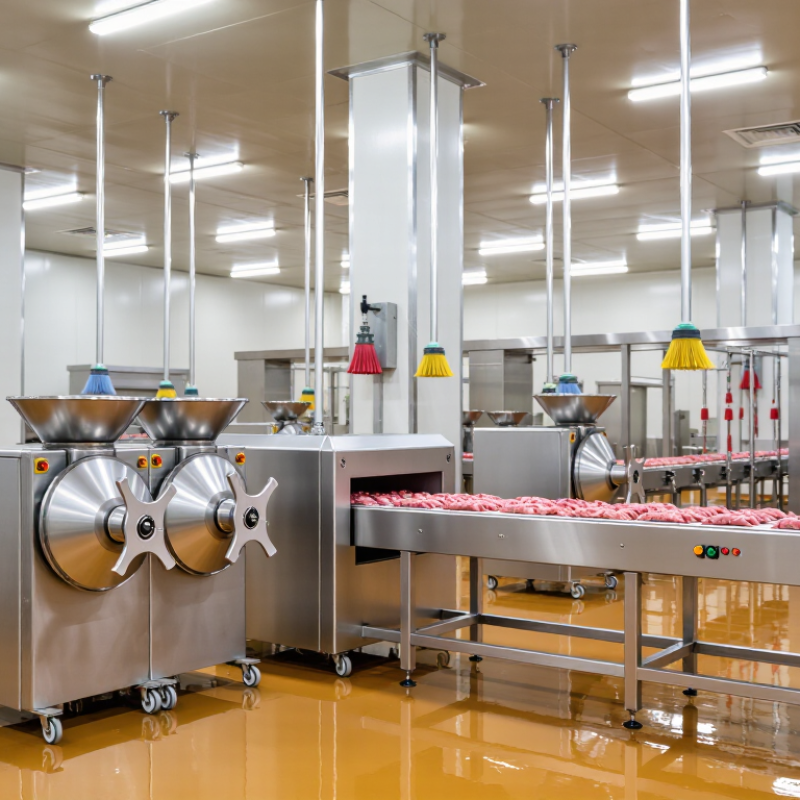
China’s Meat Processing Equipment Industry: Scope and Development
China’s meat processing equipment industry covers a broad production chain, from carcass handling and cutting to mixing, filling, cooking, chilling, and packaging. Equipment sizes range from compact machines for smaller workshops to integrated lines designed for higher-volume plants. Hygienic surfaces, easy cleaning, and steady temperature control matter as much as output speed. A polished machine is not enough.
Development is shaped by demand for consistent products, improved labor efficiency, and traceable production records. Manufacturers are adding sensors, programmable controls, and automated transfer systems, while many plants still rely on operators for adjustments and quality checks. That balance is practical, but it can leave gaps between machines. Integrating a new line with older equipment may take more planning than expected. Progress is real, though uneven across regions and facility sizes.
Tips: Assess the full workflow before choosing equipment. Check cleaning access, spare-part availability, installation space, and operator training needs. Ask for trial runs using similar raw materials; a small test can reveal jams, uneven portioning, or awkward changeovers. Be specific.
China’s Meat Processing Equipment Industry: Scope and Development
China meat production by category, 2024 (million tonnes)
Pork and poultry together accounted for most of China’s meat output in 2024, indicating the scale of processing demand across these product categories. Production volume is an indicator of the industry’s processing base, not a direct measure of equipment sales.
Source: National Bureau of Statistics of China, 2024 data.
Key Equipment Used in Meat Processing
Key equipment on a meat-processing line works as a connected system. FAO’s 2024 Statistical Yearbook puts global meat production at roughly 364 million tonnes in 2023, a scale that makes reliable handling and controlled temperatures essential. Receiving conveyors move product to inspection and weighing stations. Saws and portioning machines then prepare carcasses or cuts, while grinders and mixers create consistent particle size and blend distribution. Small details matter.
For further processing, vacuum tumblers help distribute brine through cuts, and fillers portion mixtures into casings or trays. Cooking, smoking, and chilling equipment must work together: uneven heating or slow cooling can compromise product quality and safety. OECD-FAO’s Agricultural Outlook 2024–2033 projects rising global meat consumption over the coming decade, reinforcing the need for equipment that can handle steady throughput without sacrificing process control. Sensors and temperature records are useful, but they do not replace routine inspection and cleaning. Honestly, equipment layouts can look efficient on paper and still create awkward washdown corners. Good design leaves room for operators to see, clean, and maintain each machine.
Leading Meat Processing Equipment Manufacturers in China
China’s meat-equipment manufacturers serve a large and varied processing sector. The National Bureau of Statistics of China reported 97.58 million tonnes of meat output in 2023, in its Statistical Communiqué on the 2023 National Economic and Social Development. This scale creates demand for dependable cutting, mincing, mixing, and packaging lines. Scale matters. But national output is not a direct measure of equipment sales or factory quality.
The OECD-FAO Agricultural Outlook 2024–2033 projects global meat consumption to grow by 12% over the outlook period. For buyers assessing leading manufacturers in China, practical checks matter more than impressive brochures. Ask to see a line running the same product and cut size you plan to process. Check belt tracking, weld finish, washdown access, temperature records, and changeover time. Request measured throughput and reject rates, not just rated capacity. Even good equipment can underperform when operators lack training or spare parts arrive slowly. That detail is easy to overlook. No supplier fits every plant. The published reports describe market context, not individual machine performance, so independent trials and service checks remain essential.
How to Evaluate and Compare Manufacturers
Top Meat Processing Equipment Manufacturers in China
How to Evaluate and Compare Manufacturers
Compare equipment against the product you actually process, not a showroom demonstration. Request throughput data for your target cut, temperature, and shift length. Ask whether stated capacity includes loading, cleaning, and changeovers. Small details matter. Inspect welds, guards, belt tracking, and access around motors. A polished sample can hide awkward maintenance points.
Review food-contact material specifications, electrical drawings, manuals, and spare-parts lists before comparing prices. Ask for references from plants with similar volumes, then speak with operators if possible. Test sanitation access with a realistic cleaning checklist. Look for clear service response times and training plans, not broad promises. A low quote may omit installation, tooling, or commissioning. Clarify what acceptance testing measures and who records the results. Compare warranty terms line by line. Ask what fails most often, and how long common parts take to arrive. Answers may be imperfect, and that is useful. A supplier that explains limitations can be easier to assess than one offering certainty. Evaluate documents and machine behavior together.
Top Meat Processing Equipment Manufacturers in China - How to Evaluate and Compare Manufacturers
| Evaluation Dimension | Evidence to Request | How to Compare | Buyer Notes |
|---|---|---|---|
| Product and process fit | Equipment specifications, process flow, product samples or test results, and a list of included and optional components. | Check that each proposal covers the same process steps, product type, operating conditions, and scope of supply. | A machine designed for one product or process may not perform equally well with another. |
| Capacity and performance | Rated throughput, product-size range, operating-speed range, and test conditions supporting the quoted figures. | Compare performance under equivalent product, staffing, and operating conditions; ask how output is measured. | Rated capacity is not necessarily the same as sustained production-line output. |
| Food-contact materials | Material grades for product-contact parts, material declarations, and certificates or test records where applicable. | Confirm material suitability for the intended food, cleaning chemicals, temperature, and destination-market requirements. | Stainless-steel grade selection depends on the application; do not assume one grade suits every environment. |
| Hygienic design and cleanability | Design drawings, cleaning instructions, disassembly steps, and details of product-contact surfaces and joints. | Review access for inspection and cleaning, potential residue-trapping areas, and compatibility with the intended sanitation method. | A protection rating alone does not establish that equipment has hygienic design or is easy to clean. |
| Machine safety | Risk-assessment documentation, guarding details, emergency-stop layout, and safety-control information. | Check the design against the applicable market requirements and relevant standards, such as ISO 12100 and ISO 13849-1 where applicable. | The applicable legal and technical requirements depend on the installation location and equipment configuration. |
| Electrical and controls | Electrical drawings, control-system description, component list, software backup policy, and operating-language options. | Compare control functions, alarm handling, documentation, and compatibility with site power and integration requirements. | Ask whether the supplied electrical design meets requirements for the target market, including IEC 60204-1 where applicable. |
| Quality management and traceability | Quality-management documentation, inspection records, serial-number policy, and traceability for key components. | Verify the scope and validity of any claimed certification directly with the issuing or accreditation body. | A management-system certificate does not by itself prove the performance of a specific machine. |
| Testing and acceptance | Factory acceptance test (FAT) procedure, test records, acceptance criteria, and commissioning plan. | Agree in writing on measurable acceptance criteria, test materials, test duration, and responsibility for each test. | Where feasible, observe a test using representative product and operating conditions. |
| Service and spare parts | Warranty terms, spare-parts list, recommended maintenance schedule, support channels, and response process. | Compare included support, parts availability arrangements, and the responsibilities for remote or on-site service. | Request lead times and costs for critical wear parts before purchase. |
| Installation and integration | Layout drawings, utility requirements, interface list, installation scope, and commissioning requirements. | Check compatibility with upstream and downstream equipment, site utilities, available space, and local installation conditions. | Clarify which party supplies transport, lifting, installation, training, and commissioning. |
| Total cost of ownership | Itemized quotation, energy and consumables information, maintenance needs, spare-parts pricing, and warranty exclusions. | Compare the same scope and estimate costs over a common operating period, including installation and planned maintenance. | A lower purchase price does not necessarily mean a lower lifecycle cost. |
Note: Use the same written specification and acceptance criteria when requesting quotations. Verify regulatory, food-contact, and safety requirements for the destination market and intended use.
Industry Standards and Emerging Technology Trends
Top Meat Processing Equipment Manufacturers in China: Industry Standards and Emerging Technology Trends
For Chinese meat-processing equipment, standards are not paperwork alone. They shape machine layout, materials, safety controls, and cleaning access. Buyers should check food-contact surfaces, weld finishes, drainage, guarding, and electrical documentation. Requirements differ by destination market, so certificates and test records need review against the actual installation and product.
Cleanability matters. On a line, residue can hide beneath a conveyor belt or around a poorly placed seal. Hygienic design should make inspection and routine sanitation practical, not merely promise them. Emerging systems add temperature, pressure, and motor-load sensors, helping operators spot drift before it causes downtime. Inline imaging and weight checks can support consistent portions, while traceable production data helps connect batches with process conditions. Useful, but not magic.
Automation is advancing in cutting, portioning, packing, and material handling. Flexible controls can help plants manage changing product sizes, though integration with older equipment remains difficult. Energy-efficient motors and water-conscious cleaning designs also attract attention, but claimed savings should be verified under real shift conditions.
A specification may look excellent on paper. Ask for sample records, cleaning demonstrations, and performance data from comparable operating conditions. Manufacturers that explain limits as clearly as capabilities offer a more dependable basis for evaluation.
Related Posts
-
Exploring the Latest Innovations in Meat Equipment Technology for Enhanced Food Safety and Quality
-
2026 Top Meat Equipment Suppliers for Global Buyers
-
5 Essential Trends in Commercial Meat Processing Equipment for Global Buyers
-

The Evolution of Meat Processing Equipment for Global Buyers
-

Leading Industrial Meat Processing Equipment Manufacturers from China at the 137th Canton Fair
-
Excellence in Manufacturing Transforming Global Meat Processing with Chinese Innovation