
China Top Industrial Food Processing Equipment Suppliers?

Choosing China’s top suppliers of Industrial Food Processing Equipment requires more than comparing prices or browsing polished factory websites. Buyers must examine manufacturing experience, engineering capability, quality controls, and after-sales support. A reliable supplier should explain how its machines handle real production conditions, including heat, moisture, cleaning chemicals, and continuous operation.

Look closely at equipment details. Stainless steel grades, weld quality, motor brands, control systems, and hygienic design can affect safety and maintenance costs. Ask for factory videos, test reports, installation records, and references from food processors with similar products. A supplier experienced with sauces may not understand the demands of frozen vegetables or powdered ingredients.

Factory visits can reveal useful evidence.

However, no supplier is perfect. Some companies offer excellent fabrication but limited international service. Others provide strong automation yet depend heavily on imported components. Delivery promises may also change when designs require customization. These limitations deserve honest attention, not promotional language.

This guide compares leading Chinese manufacturers through practical criteria, including product range, customization, certifications, production capacity, export experience, and technical support. It also considers how suppliers communicate before and after an order. Clear drawings, realistic specifications, spare-parts planning, and operator training often matter more than a low quotation.

The “top” supplier depends on your process, budget, factory layout, and risk tolerance. Evidence should guide the decision. Careful verification remains essential.
China Top Industrial Food Processing Equipment Suppliers?

What Defines a Top Industrial Food Processing Equipment Supplier?

What Defines a Top Industrial Food Processing Equipment Supplier?

A top supplier understands the food process, not only the machinery. Its engineers ask about ingredients, moisture, temperature, batch size, and cleaning routines. They study how operators work beside the equipment. That practical attention often prevents costly design mistakes.

Not just stainless steel.

Hygienic construction is essential. Smooth welds, accessible components, proper drainage, and suitable seals reduce contamination risks. A reliable supplier provides clear drawings, material records, operating instructions, and maintenance schedules.

Testing should reflect real production conditions, including heat, pressure, and repeated cleaning. Technical claims need evidence, not attractive wording.

Strong after-sales support also defines a serious supplier. Experienced technicians can guide installation, training, troubleshooting, and replacement-part planning. Response time matters when a mixer stops during a scheduled production run.

However, no supplier gets every decision right. A capable one admits limitations and suggests practical alternatives. Buyers should inspect reference projects, ask detailed questions, and verify performance data.

A polished factory tour helps, but it cannot replace documented results.

Even experienced teams may overlook noise, operator access, or future capacity. Honest discussion exposes those weak points before equipment reaches the production floor.

How China’s Food Processing Equipment Industry Is Organized

China’s food processing equipment industry is organized as a layered manufacturing network rather than a single, unified market. Large engineering firms often design complete lines for products such as dairy, beverages, grains, and prepared foods. Smaller manufacturers supply mixers, conveyors, filling units, pumps, sensors, and stainless steel tanks. This structure allows flexible sourcing, but equipment quality can vary between suppliers.

Industrial clusters usually connect machinery producers with metalworking shops, automation specialists, electrical contractors, and testing laboratories. A processing line may be assembled in one city while its control cabinet, valves, and packaging modules come from several provinces. Experienced buyers examine the entire supply chain, not only the final assembler. Factory audits, material certificates, hygiene documentation, and factory acceptance tests provide useful evidence of reliability.

China’s leading suppliers are often identified by engineering capability, documented installations, export experience, and after-sales support. They should explain cleaning procedures, changeover time, production capacity, and spare-parts availability in measurable terms. Site visits can reveal details that brochures hide, such as uneven welds, cramped maintenance access, or unclear cable labeling. Small details matter.

The industry is not perfectly standardized. Some suppliers communicate technical limits clearly, while others promise more than their machines can deliver. That is a warning. Buyers should request product trials using realistic ingredients, temperatures, viscosity levels, and packaging materials. A careful procurement process may take longer, but it reduces costly redesigns after installation.

China Top Industrial Food Processing Equipment Suppliers? - How China’s Food Processing Equipment Industry Is Organized

Industry Dimension Main Equipment Segment Typical Industrial Applications Relevant Classification or Standard How Suppliers Are Commonly Organized
Raw-material preparation Cleaning, sorting, grading, peeling, cutting and crushing machinery Grains, vegetables, fruit, meat, seafood and prepared-food production Generally included in HS 8438 when used for industrial food or drink preparation Often supplied by specialized machinery manufacturers or by engineering companies as part of a complete line
Mixing and forming Mixers, kneaders, emulsifiers, depositors, moulders and forming systems Dough, bakery products, sauces, beverages, meat products and convenience foods Food-contact components are commonly designed with reference to China’s GB 4806 food-contact material series The market includes both standard-machine suppliers and application-focused custom builders
Thermal processing Steamers, blanchers, dryers, ovens, fryers, pasteurizers and sterilizers Baking, cooking, dehydration, pasteurization and commercial sterilization Thermal equipment may involve pressure-equipment requirements under applicable Chinese regulations and standards Suppliers are usually divided into atmospheric-temperature equipment specialists and pressure or retort-system specialists
Separation and concentration Filters, centrifuges, evaporators, membrane systems and separators Dairy, beverage, starch, edible-oil, fermentation and ingredient processing Equipment selection is normally based on product viscosity, solids content, temperature and hygienic design requirements This segment is more engineering-intensive and frequently involves process validation and pilot testing
Filling and packaging Filling, capping, sealing, labelling, wrapping and case-packing machines Bottled beverages, canned foods, dairy products, snacks, powders and frozen foods Packaging machinery is commonly classified under HS 8422; food-processing machinery is commonly classified under HS 8438 Suppliers range from single-machine manufacturers to complete packaging-line integrators
Conveying and material handling Belt conveyors, screw conveyors, bucket elevators, pumps and robotic handling systems Movement of ingredients, containers and finished products between processing stages Hygienic construction, cleanability, guarding and electrical safety are key design considerations Typically provided by component specialists, line builders or as an integrated module within a turnkey project
Refrigeration and freezing Blast freezers, tunnel freezers, cold rooms and refrigeration systems Frozen vegetables, seafood, meat, bakery products and prepared meals System design must address refrigerant safety, temperature control, insulation and energy efficiency The supply base includes refrigeration contractors, cold-chain integrators and process-equipment manufacturers
Cleaning and sanitation Clean-in-place systems, foam-cleaning systems, sterilization units and hygienic utility skids Dairy, beverage, brewing, sauce, liquid-food and pharmaceutical-food facilities Design commonly considers hygienic engineering principles, food-contact safety and validated cleaning procedures Usually delivered by process-line integrators or specialist hygienic-fluid-system suppliers
Automation and controls Sensors, programmable control systems, supervisory software, weighing and inspection systems Recipe control, traceability, quality inspection, production monitoring and energy management Industrial electrical safety, electromagnetic compatibility and machine-guarding requirements may apply Automation is supplied by control-system integrators, equipment manufacturers and specialized software developers
Turnkey engineering Complete processing lines, factory utilities, installation, commissioning and validation Large-scale food, beverage, dairy, meat, grain and prepared-food plants Projects may require compliance with Chinese food-production, construction, fire-safety and environmental regulations The integrator coordinates multiple equipment categories instead of manufacturing every machine internally
Export readiness Machines and lines prepared for overseas installation and operation Projects serving Asia, the Middle East, Africa, Europe and the Americas Common requirements include CE conformity for applicable European markets, electrical documentation, risk assessment and multilingual manuals Export-oriented suppliers usually compete through customization, price, delivery capability, spare parts and remote service
Supplier evaluation Technical capability, manufacturing quality and after-sales support Factory acceptance testing, installation, operator training and lifecycle maintenance ISO 9001 certification, documented quality procedures and compliance evidence are commonly reviewed by buyers The strongest procurement process compares technical fit, validated output, hygienic design, total cost and service response time
Reference framework: The classification and compliance references in this table are based on commonly used international customs headings, China’s GB 4806 food-contact-material standards, applicable Chinese machinery and food-production requirements, ISO 9001 quality-management principles, and CE requirements for relevant export markets.

Major Equipment Categories and Their Industrial Applications

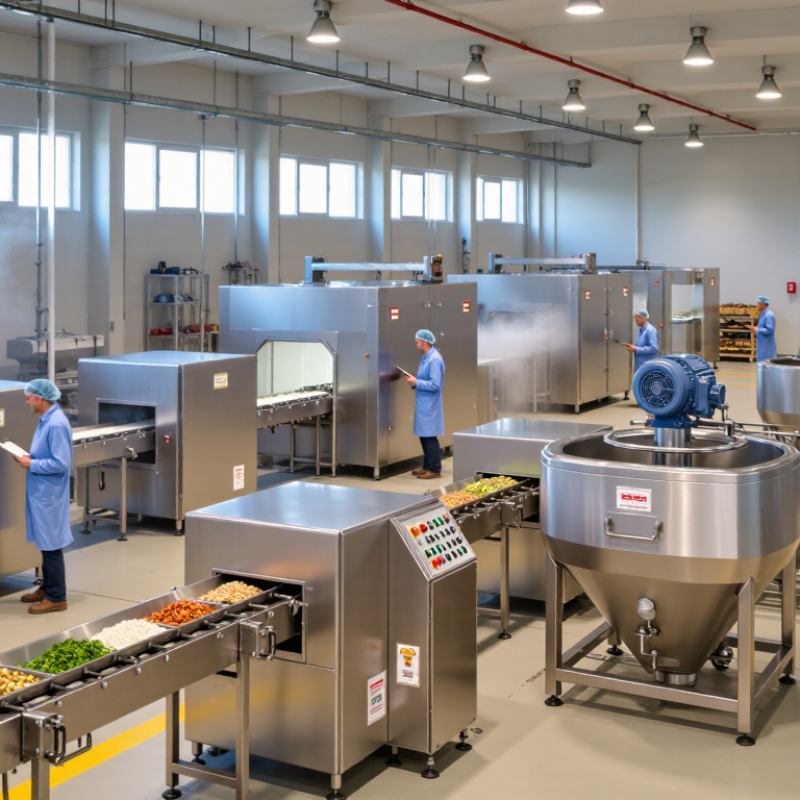
China’s industrial food processing equipment sector covers several distinct categories. Mixing and blending systems serve sauces, dairy bases, beverages, and powdered ingredients. Cutting, grinding, and emulsifying machines support meat alternatives, prepared foods, and uniform fillings. Thermal equipment, including steam cookers, ovens, and continuous fryers, controls texture and microbial safety. It also affects energy use.

According to Grand View Research’s 2024 Food Processing Equipment Market report, the global market exceeded US$50 billion in 2023 and is expected to grow steadily through 2030. This growth reflects demand for automated, hygienic, and flexible production lines. Chinese suppliers commonly provide pasteurizers, retorts, dryers, filling systems, and complete process modules for different factory scales. A small sauce plant may need a jacketed kettle and inline mixer. A frozen-food facility requires blanchers, spiral freezers, conveyors, and inspection equipment.

Cold-chain and preservation applications deserve careful attention. The UNEP Food Waste Index Report 2024 estimated that 1.05 billion tonnes of food were wasted in 2022. Better chilling, drying, sealing, and portion control can reduce avoidable losses, although equipment alone cannot solve weak storage management. In supplier evaluations, buyers should check stainless-steel grades, cleaning access, temperature-recording accuracy, spare-part availability, and validated output capacity. Claimed capacity can look impressive. Real performance may change with product viscosity, humidity, and operator skill. Pilot testing is still the safer choice.

China Top Industrial Food Processing Equipment Suppliers: Major Equipment Categories and Their Industrial Applications

The chart compares representative industrial process temperatures commonly associated with major food-processing equipment categories. Actual settings vary by product, process design, food-safety requirements, and production scale.

Reference points include HTST milk pasteurization at 72°C for 15 seconds, UHT processing typically above 135°C for a few seconds, blanching around 85°C, baking commonly around 180°C, spray-drying inlet temperatures around 180°C, and IQF freezing air temperatures around −35°C.

Quality Standards and Certifications for Chinese Suppliers

When evaluating China’s top industrial food processing equipment suppliers, quality certificates deserve close attention. ISO 9001 shows that documented quality procedures are in place. ISO 22000 and HACCP support food safety management, but they do not guarantee perfect equipment. Their scope and expiry dates must be checked carefully.

During factory visits, inspect stainless steel grades, weld quality, surface roughness, and cleaning access. Ask for material certificates and traceability records for product-contact parts. A reliable supplier should explain calibration routines, pressure tests, and factory acceptance testing. CE documentation may support equipment sold in applicable markets, but buyers should verify its exact relevance. My experience is that polished documents can hide weak production controls. Ask for recent audit reports.

Tips: Request certificate copies early. Confirm the issuing body independently. Compare the certificate address with the manufacturing site. Review sample inspection records, not only promises. Arrange a video inspection when travel is difficult. Keep every technical change in writing. Small gaps matter. One overlooked gasket material can affect hygiene, maintenance, and production downtime. Suppliers may also use different interpretations of “food grade,” so define approved materials, tolerances, and cleaning procedures in the contract. A pilot run can reveal problems that drawings miss.

How to Evaluate and Select a Reliable Equipment Supplier

Choosing a reliable industrial food processing equipment supplier requires more than comparing prices. Grand View Research estimates that the global food processing equipment market will expand steadily through 2030, driven by automation, hygiene, and production efficiency. This growth creates more choices, but not every supplier offers equal engineering quality.

Request verified case studies from facilities with similar products, capacities, and cleaning routines. Review equipment drawings, material specifications, safety documentation, and factory acceptance test records. Stainless steel grade matters, especially around salt, moisture, and acidic ingredients. Ask how the supplier controls weld quality, surface finish, and hygienic drainage. PMMI industry reports also identify labor shortages and automation as major investment drivers. Therefore, check whether the proposed system reduces manual handling without creating difficult maintenance tasks.

Tips: Build a scoring sheet before contacting suppliers. Include uptime targets, changeover time, water consumption, spare-part availability, response time, and total ownership cost. Request references you can call, not only polished photographs. A low quotation may hide installation delays, software limits, or expensive imported parts. I have seen evaluation teams focus heavily on purchase price and overlook cleaning validation. That is a costly blind spot. Leave room for doubt. Ask what the equipment cannot do, and require those limitations in writing. Consider an on-site audit, because a confident presentation is not proof of manufacturing discipline.

Shopping Cart
Scroll to Top

Search for...

The Duravant family of operating companies serve the food processing, packaging and material handling segments.